
Written and reviewed by
Antonia Moosmann
Psychologist in Germany, M.Sc. Clinical Psychology. I wrote individual reviews of both platforms — this page is the head-to-head I'd run if a reader asked me which to pick.
Read more about how I reviewKey facts
In a hurry? Here's the short version.
- The deciding question is your insurance. If your plan is in-network with Talkspace (Aetna, Cigna, Optum, UnitedHealthcare, TRICARE, BCBS, Medicare in select states, many employer plans), start there — copay typically $15–$30, often $0.
- If you're paying out of pocket and don't need psychiatry, BetterHelp is usually slightly cheaper and has the larger therapist pool + cleaner switching flow.
- If you need therapy + medication on one platform, Talkspace — BetterHelp doesn't prescribe at all.
- Both have privacy histories worth knowing. BetterHelp's 2023 FTC settlement is one large fixed incident with enforceable remediation. Talkspace has two separate named issues across five years.
- For most readers most of the time, neither is dramatically better than the other. The therapist matters more than the platform — switching when the first match isn't right is the most useful skill on either.
If your insurance covers Talkspace, that's the entire decision in one sentence. If it doesn't, BetterHelp is usually the better default. Everything else is detail.
Why I wrote this
The version of this question that actually helps
Most "Talkspace vs BetterHelp" articles online are written by one of the two companies (and tilt accordingly), or by review sites paid by both. I have no stake in either — I wrote separate reviews of Talkspace and BetterHelp, and this page is the head-to-head I'd run if a reader asked me which to pick.
The short version, before the table: these two platforms are closer than the marketing makes them sound. Similar matching flows, similar weekly-session model, similar messaging-plus-live design, similar credentialed clinicians. The differences that actually matter for most readers come down to four things — insurance, psychiatry, price (without insurance), and switching ease. The rest is margins.
The side-by-side
Talkspace vs BetterHelp at a glance
Read the table left-to-right. The dimension is named in the left column; the two platforms compared next to each other on that dimension. Scroll horizontally on mobile.
| What you're comparing | Talkspace | BetterHelp |
|---|---|---|
| Best for | Readers whose insurance is in-network with Talkspace, or who need psychiatry on the same platform. | Readers paying out of pocket who want the largest therapist pool and fastest match. |
| Cash-pay starting price | $69/week (messaging-only); $99/week with live video. | $65–$100/week, billed every 4 weeks (so 13 cycles a year, not 12). |
| Insurance coverage | In-network with Aetna, Cigna, Optum, United Healthcare, TRICARE, BCBS, Medicare in select states, many employer plans. Avg copay $15–$30; ~⅓ of insured users pay $0. No Medicaid. | Began accepting some plans in Jan 2026, but most readers still pay out of pocket. Confirm with your specific plan first. |
| Psychiatry / medication | Yes — same platform, separate plan. Non-controlled medications only. Cash-pay: $299 initial, $175 follow-up. | No prescribing at all. You'd need a separate prescriber. |
| Session formats | Messaging-only, messaging + 30-min video, messaging + video + group workshops. | Weekly live session (video, phone, or live chat — your pick) plus async messaging between. |
| Therapist matching | Algorithm picks based on intake. ~83% first-match satisfaction per surveys. Switching is more cumbersome than BetterHelp. | Algorithm picks based on intake. Switching flow is one of the better-designed parts of the app. |
| Network size | Thousands of therapists, but the pay model attracts higher turnover and newer providers. | One of the largest US online therapy networks; first match usually arrives within 1–2 days. |
| Evidence base for the actual format | 30+ peer-reviewed studies with Columbia, Harvard, NYU. Published evidence specifically on messaging-based therapy. | Sits inside the broader telehealth evidence band. Far less independent peer-reviewed data on the specific platform. |
| Privacy track record | 2020 NYT reporting on session-transcript mining; August 2024 class action over TikTok pixel tracking on the public site. Two named issues across five years. | 2023 FTC settlement ($7.8M) over sharing sensitive health data with Meta and Snapchat. Now under enforceable privacy programme with third-party audits. |
| Where it disappoints | Therapist response times can stretch beyond the 5-day guarantee during high-load periods. Cumbersome switching. | Customer support is slow (~43% of contacts wait >2 days). Four-week billing is easy to misread as monthly. |
Pick Talkspace if
When I'd pick Talkspace
Four situations where Talkspace is the clear answer. The first one is the most common — and the most expensive to get wrong by ignoring.
- Your insurance is one of theirs
Aetna, Cigna, Optum, United Healthcare, TRICARE, BCBS, or Medicare in your state. With in-network coverage the price gap to BetterHelp closes — or reverses. Verify your specific plan in your member portal first; the intake will also estimate your copay.
- You need therapy and medication management
Talkspace is one of the few platforms that does both on a single account. BetterHelp doesn't prescribe at all. If you're already on SSRIs, SNRIs, mood stabilisers, or non-stimulant ADHD medication and you want therapy in the same place, Talkspace is the answer. (Controlled substances stay out of reach on any online platform.)
- You write better than you talk
Talkspace's messaging-only tier at $69/week is a genuine asynchronous-therapy product backed by peer-reviewed evidence for depression and anxiety. Few platforms treat messaging as a first-class plan; Talkspace is one of the ones that does.
- You want published research specific to the format
If "is there evidence for what I'm buying?" is a real filter, Talkspace publishes more peer-reviewed research on its own platform than any direct competitor. The evidence is for mild-to-moderate symptoms — meaningful, not universal.
Pick BetterHelp if
When I'd pick BetterHelp
Four situations where BetterHelp is the clearer fit — most of them come down to out-of-pocket cost, network depth, or scheduling flexibility.
- You're paying out of pocket
Without insurance, BetterHelp at $65–$100/week (effectively ~$300/month at the low end) is usually a touch cheaper than Talkspace's video tiers. The gap isn't huge — but it's real, and the financial-aid programme can knock another 10–20% off for readers who qualify.
- You want the fastest match and biggest pool
BetterHelp has one of the largest US therapist networks in online care. Most readers get an initial match within 1–2 days. If your first match isn't right, the switching flow is one of the cleanest in the category — designed to be quick, no awkward conversation.
- Scheduling is your bottleneck, not money
Evening and weekend coverage is genuinely deep at BetterHelp because the network is large. A 7pm or Saturday-morning slot is usually achievable — not always on the first match, but reliably on the second. Talkspace can do this too, but BetterHelp's depth is meaningfully better here.
- You want flexibility in session format
BetterHelp lets you do each weekly session as video, phone, or live chat — your call. Useful for readers whose preferred format shifts week to week (camera-off day, phone-walk day, real-conversation day).
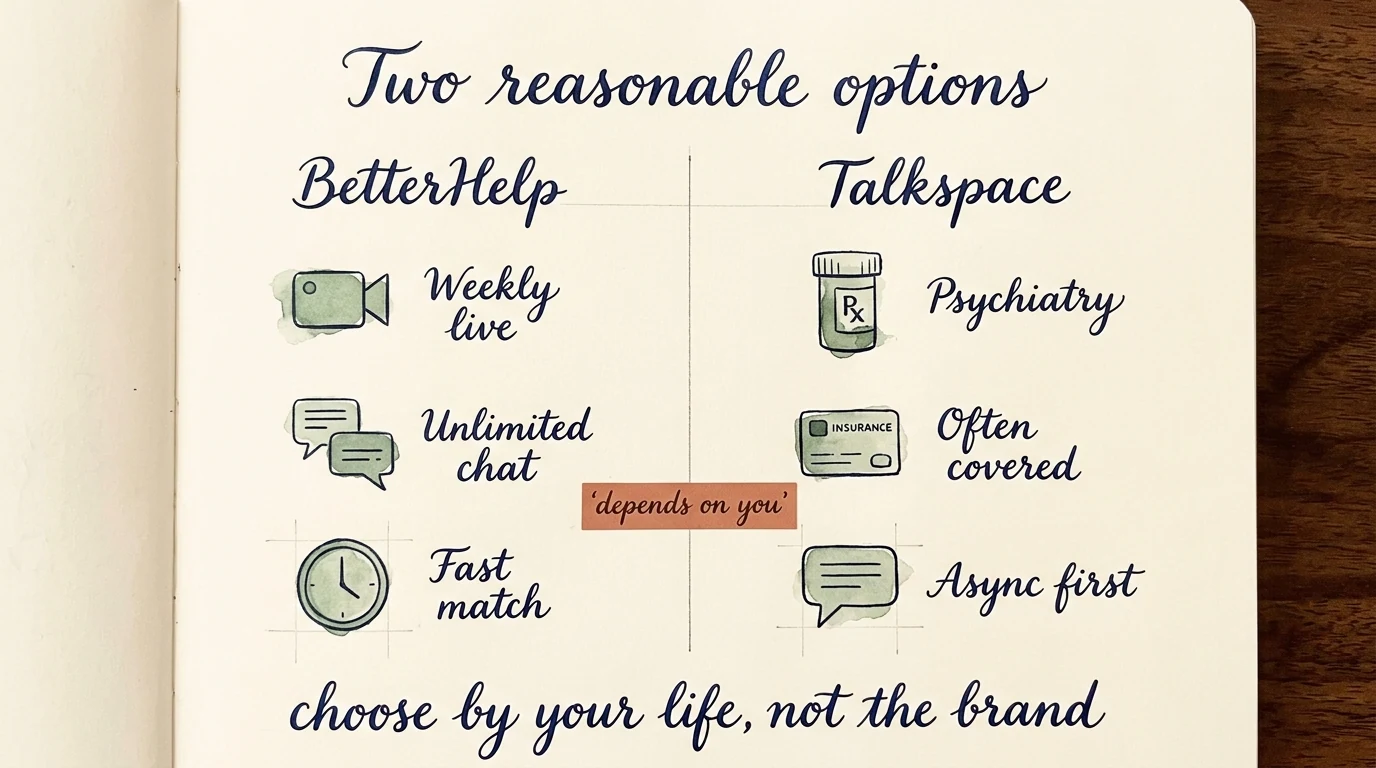
It's almost never about the platform with the better marketing. It's about the platform that fits the life you're actually living — your insurance, your schedule, your communication style, your wallet.
When neither fits
When the right answer isn't on this page at all
Five situations where I'd push back if a reader was choosing between Talkspace and BetterHelp — because the right answer isn't either of them.
- Active crisis or self-harm. Neither platform is built for the moment of danger. Call 988 (US), Samaritans (UK), or Telefonseelsorge in Germany first.
- Severe symptoms, complex trauma, or close-monitoring needs. Acute psychosis, severe eating disorders, active substance use disorders, and complex/developmental trauma usually need in-person or specialist care. The format limits matter.
- Medicaid is your only coverage. Neither platform accepts Medicaid. Look at community mental health centres via SAMHSA's directory.
- You want to pick a specific therapist by name first. Both use opaque matching. If you want to read named clinicians' profiles before paying, Psychology Today's directory is usually the better starting point.
- You'd rather start with a workbook. For mild-to-moderate symptoms, structured self-help often carries the work — and costs a fraction. See do you actually need a therapist? for the threshold.
If you've decided
Next step depends on your answer to one question.
Is your insurance in-network with Talkspace? (Aetna, Cigna, Optum, UnitedHealthcare, TRICARE, BCBS, Medicare in select states, or many employer plans.)
If yes:
Read the Talkspace review →Copay typically $15–$30; nearly a third of insured users pay $0.
If no, or if you need fastest match + largest pool:
Read the BetterHelp review →Out-of-pocket starting around $65/week, large therapist pool, clean switching flow.
Still not sure you need a therapist at all? Start with do you actually need a therapist? — the threshold framework for when a workbook is enough.
If you need integrated medication management and a structured crisis pathway alongside therapy — closer to managed care than a marketplace — the Brightside Health review covers the alternative neither Talkspace nor BetterHelp matches.
A note on sources
Pricing, insurance coverage, modality support, and platform features are pulled from each company's public pricing pages, help center documentation, and the individual reviews on this site (linked above). Privacy-history claims reference the publicly filed 2023 FTC settlement with BetterHelp, the 2020 New York Times reporting on Talkspace's transcript-mining practices, and the August 2024 California class action over Talkspace's TikTok pixel tracking on its public website. Therapist-matching satisfaction rates come from independent user surveys cited in each platform's review.
Where I've made a specific recommendation, I'm following the consensus pattern in the broader telehealth literature: match the platform to the reader's insurance, communication style, and prescribing needs — and treat therapist fit as the higher-order question on either platform.
Common questions
Which one would you pick if you had no insurance?
Out of pocket, BetterHelp at $65/week (low end) is usually slightly cheaper than Talkspace's video tier — about $50–$80/month less depending on the tier. If you don't need psychiatry and you write OK aloud, BetterHelp is the cheaper default. If you'd use the messaging-only product (and you genuinely communicate that way), Talkspace's $69/week messaging plan is the cheapest live-clinician option on either platform.
Which one wins on therapy quality?
Honestly: neither, on average. Both have credentialed licensed clinicians and both have wide variation in experience and fit. Therapy quality is more a function of the therapist than the platform on either of these. The first-match-success rate is roughly similar (~80% range). Switching when the fit is wrong is the most useful skill on either platform — BetterHelp's switching flow is the better-designed one.
Which has the worse privacy history?
Both have named issues. BetterHelp's 2023 FTC settlement ($7.8M) was a single large incident with sanctions and an enforceable remediation programme since. Talkspace has two separate named issues across five years — 2020 NYT reporting on session-transcript mining for product development, and an August 2024 class action over TikTok pixel tracking on the public site. Neither pattern is a clean record. The honest take: read the full notes in the BetterHelp review and the Talkspace review, then decide for yourself whether either history is a dealbreaker.
Can I use either one outside the US?
BetterHelp matches some international users with therapists in their region (UK, Canada, Australia, parts of the EU), but licensing rules mean fewer therapists and longer matches outside the US. Talkspace is essentially US-only — no support for international plans. For European readers, local-licensed telehealth (Instahelp in DE/AT, Selfapy for self-guided programmes, or the public mental-health system) is usually the better first step.
If I'm not sure which to try, which would you recommend first?
Open your insurance member portal first. If Talkspace is in-network for your specific plan, start there — the cost case almost certainly wins. If Talkspace isn't in-network or you're paying out of pocket, BetterHelp is the better default for most readers. If you'd prefer to settle the question with a single concrete decision, see the questions to ask a therapist checklist — most of them apply to both.
What if I'm not even sure I need a therapist at all?
Reasonable starting question. The do you actually need a therapist? guide walks through when a workbook is enough, when to talk to someone, and the grey-zone signs in between. If you land on "workbook," the CBT workbooks I'd actually keep are sorted by what's going on.