
Written and reviewed by
Antonia Moosmann
Psychologist in Germany, M.Sc. Clinical Psychology. I write these guides the way I'd answer the question if you asked me in person — naming where self-help is enough, where it isn't, and where the marketing runs ahead of the research.
Read more about how I reviewKey facts
In a hurry? Here's the short version.
- A workbook is usually enough if your symptoms are mild-to-moderate, tied to a clear and time-limited stressor, your functioning is mostly intact, there are no safety concerns, and you'll actually do the exercises rather than just read them.
- I'd push you toward a therapist if symptoms have lasted four or more weeks without shifting, functioning is taking real hits (work, relationships, sleep), there's any safety signal, the problem is relational or developmental, or you've tried honest self-help and the needle didn't move.
- The grey zone is real. Six to eight weeks of consistent workbook use is a fair test before deciding. Self-help and therapy aren't competitors — many people use both.
- If you're in danger, this page is the wrong page. Please use a crisis line first: 988 (US), Samaritans (UK), or Telefonseelsorge 0800 111 0 111 (Germany).
- Where to go next: CBT workbooks I'd keep · DBT workbooks for each situation · which therapy fits which problem · is online therapy effective? · BetterHelp review.
The platforms you've already opened in another tab have a structural problem answering this question: their answer is always "you need a therapist." Mine isn't — sometimes a workbook is genuinely enough.
Start here
The honest version of the question
If you've Googled "do I need a therapist," most of the top results are pages written by companies that sell therapy. They have one answer to give you, and it's the answer their business depends on. I don't blame them — but it's worth knowing that's what you're reading.
The honest version, written by someone who doesn't sell therapy: sometimes a workbook is enough; sometimes it isn't; the difference is specific and worth knowing. The rest of this page is the specifics.
First — what we mean by "self-help"
What "self-help" actually means here
I don't mean a stack of vague wellness books. I mean structured, evidence-backed self-help: a CBT or DBT workbook designed by a clinician, used the way it's meant to be used — exercises completed, not just read. The CBT workbooks I'd actually keep and the DBT workbooks for each situation are sorted by what's going on for the reader, not by which book is most popular. Free public-health PDFs from the UK's NHS, Australia's Centre for Clinical Interventions, and the US Therapist Aid sit alongside the paid books and do real work for many readers.
Apps like Headspace and Calm are useful for daily practice — but they sit further from therapy than a workbook does, not closer. The therapy apps comparison covers when each one fits.
The rest of this page assumes you mean "structured workbook, done honestly" when I say self-help.
Threshold one
When a workbook is enough
Six signs that tell me self-help is a reasonable first move — sometimes the only move needed.
- Symptoms are mild and intermittent
A bad week or two of anxiety or low mood, tied to something specific (a deadline, a breakup, a move). The kind of thing you'd describe as 'I'm not myself this month.'
- There's a clear, time-limited stressor
Job change, exam season, a difficult conversation coming up, a recent loss that's still recent. Workbook + time + community support carries this for most people.
- You're functioning
Showing up at work or school. Maintaining relationships. Sleeping, eating, and moving — imperfectly, but functionally.
- No safety concerns
No thoughts of self-harm. No urges to harm anyone else. Not coping with substances in a way that scares you.
- You've never tried structured self-help before
A well-chosen CBT or DBT workbook is genuinely the right first step for many people. It's not a consolation prize.
- You can be honest with yourself on paper
Workbook self-help works when you'll actually do the thought records, the exposure ladder, the behaviour experiments. If you'll skim and feel better-informed but not different, it won't carry you.
Threshold two
When I'd push you toward a therapist
Seven signs that tell me the workbook isn't the right tool — or at least, not the right tool alone.
- Symptoms have lasted four-plus weeks and aren't shifting
The line isn't 'one bad month'; it's 'one bad month that hasn't moved despite trying.' Persistent, not just present.
- Functioning is taking real hits
Missing work. Cancelling on people repeatedly. Not eating, not sleeping, or both for weeks. The cost is showing up in your life, not just inside your head.
- Any safety signal — even quiet ones
Thoughts of self-harm. Thoughts of not being here. Active urges to use substances or behaviours in ways that hurt you. None of those are workbook territory. Please reach out — the safety callout below has crisis lines.
- You've tried self-help, honestly, and it didn't move things
Six to eight weeks of consistent workbook use with no shift is data. Not a failure — data. A therapist can do work a book can't.
- The problem is relational, recurring, or developmental
Patterns that keep repeating. Difficulty in close relationships that you've noticed for years. Childhood that still feels live. These are formats a workbook is too thin for.
- Substances or behaviours are doing more work than you'd like
Drinking, weed, food, scrolling, sex, gambling — when any of these is the main coping tool, you usually can't workbook your way out of it alone.
- A previous workbook 'worked' but the thing kept coming back
Recurrent depression, anxiety that returns every season — recurrence is the signal that one more book probably isn't the answer.
Six to eight weeks of consistent workbook use with no shift isn't a failure. It's data. Useful data — the kind a therapist can do something with.
The middle ground
The grey-zone signs (and what I'd actually do)
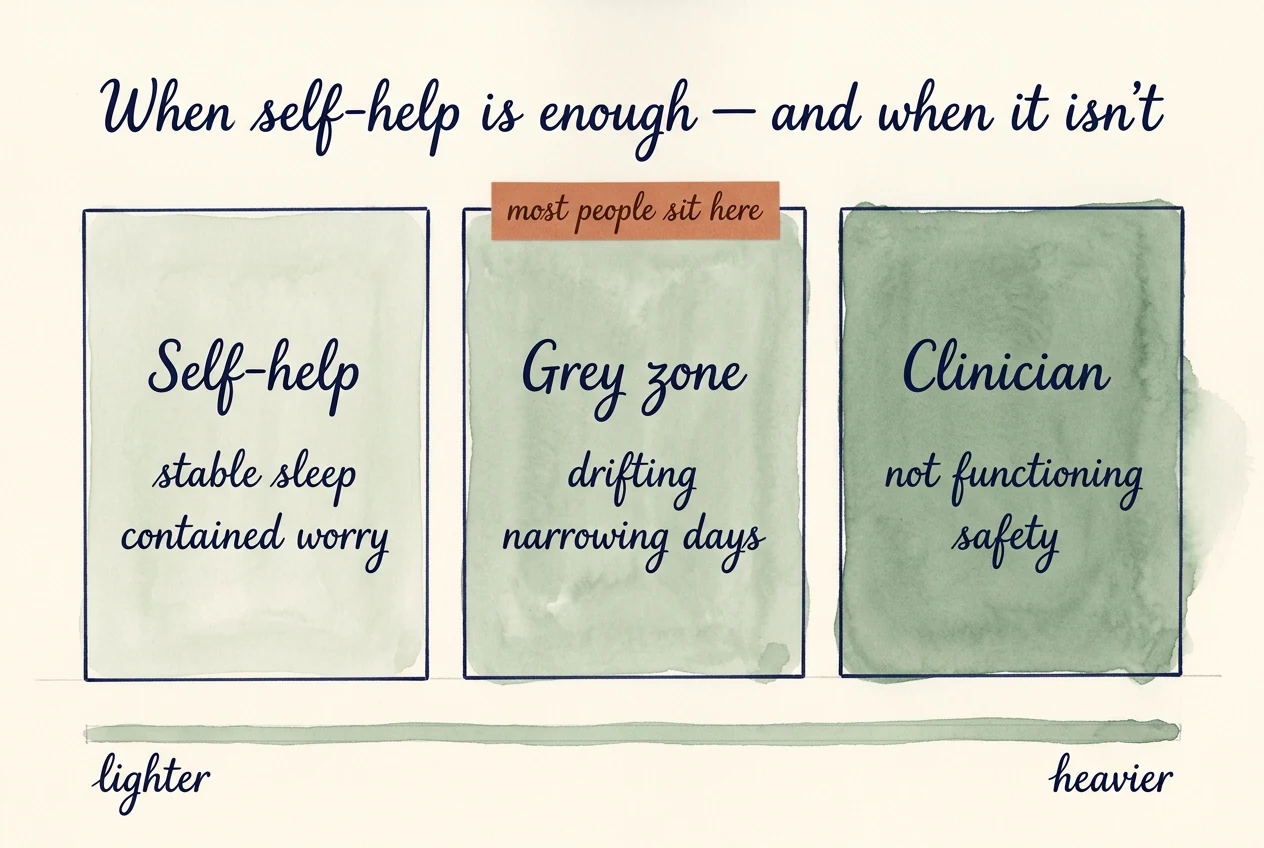
The two lists above are the clearest cases. Most readers land somewhere in between. Here are the four most common grey-zone situations and where I'd go.
Moderate symptoms, no safety concerns, but you're not sure
What I'd do: Pick one good workbook, commit to it for six to eight weeks. Reassess honestly at the end. If you've done the work and the needle hasn't moved, that's your data.
You'd like a therapist but can't afford one
What I'd do: A workbook + the free public-health PDFs I cover on the workbook pages is a real starting point, not a placeholder. Pair with the local mental-health resources in your country.
You can afford therapy but feel embarrassed to ask
What I'd do: Self-help first is sometimes a useful proof-of-effort to yourself — but if cost isn't the barrier, the embarrassment usually shrinks once you're in the room.
You're already in therapy and wondering if it's enough
What I'd do: A workbook between sessions almost always helps. Bring what's coming up in the workbook back into session. That's the ideal combination.
The honest both-sides
What each tool can't do for you
One reason this decision gets stuck is that people frame it as "which works." The more useful frame is "which work does each one not do." Both lists are short and worth reading before you decide.
What a workbook alone can't replace
- Co-regulation — a calm nervous system across from yours.
- Real-time feedback when you're stuck or off-track.
- Accountability you can't quietly skip.
- Safety monitoring when something gets dark.
- A relationship long enough to notice patterns you can't see in yourself.
- The specific protocols that need a trained human (ERP for OCD, CBT-E for eating disorders, full DBT for severe emotion dysregulation).
What a therapist alone can't replace
- The 167 hours a week you're not in session.
- Daily practice — thought records, exposure ladders, behaviour experiments.
- The new habits that only stick with reps you can't do in an office.
- Generalising the skills outside the room.
- Catching the pattern in the moment it happens (a journal does this better than memory).
- The cheap, repeatable maintenance after the active work is done.
The pattern most clients I've worked with land on isn't "workbook vs therapist." It's "workbook plus therapist for the active stretch; workbook alone for maintenance."
If you've decided
A handful of actual next steps
A note on sources
The thresholds above are a working clinician's distillation of three overlapping bodies of evidence: the broader self-help effectiveness literature (Bower, Cuijpers, and colleagues on guided and unguided self-help for depression and anxiety), the American Psychological Association's guidance on treatment length and severity , and standard clinical-practice thresholds used in public-health systems (NHS Talking Therapies, German Kassen-system referral criteria) for when self-help is offered as first-line care versus when therapist-delivered care is indicated.
Where I've drawn a sharp line — safety signals, severe symptoms, specific protocols — I'm following the same consensus the major guidelines follow. Where I've left a grey zone explicitly grey, that's because the evidence does too.
Common questions
Is using a workbook instead of seeing a therapist just settling?
No. A well-chosen workbook delivered to a motivated reader produces real, measurable benefit for mild-to-moderate anxiety, low mood, sleep difficulty, and many other common problems. The research on self-administered CBT is consistent — it underperforms therapist-delivered CBT, but it outperforms doing nothing by a wide margin. For the right problem at the right severity, it's not a consolation prize; it's a legitimate first step.
How long should I try self-help before deciding it isn't enough?
Six to eight weeks of consistent work is a fair test. "Consistent" means actually doing the exercises — not just reading the chapters. If you've done the thought records, the behaviour experiments, or the exposure ladders for six to eight weeks and nothing has shifted, that's useful data. It doesn't mean self-help can't help anyone like you; it means this particular attempt didn't, and a therapist is the next step.
Can I do therapy AND use a workbook?
Yes — and most therapists prefer it. The workbook does the between-session work; the therapist does the live work. Bring what comes up in the workbook back into session. The combination tends to move faster than either alone. If you're doing CBT-flavoured therapy, the CBT workbooks I'd actually keep pair well; for DBT, the DBT workbooks for each situation are written for between-session practice.
What if I can't afford therapy?
Three real options. First, a good workbook plus the free public-health PDFs (the UK NHS, Australia's Centre for Clinical Interventions, and the US Therapist Aid all publish excellent free materials) is a genuine starting point. Second, in many countries public mental health is more accessible than people realise — NHS Talking Therapies in the UK, gesetzliche Krankenkassen in Germany, community mental health centres in the US. Third, training-clinic therapy (graduate students supervised by licensed clinicians) is available in most cities at heavily reduced rates. None of these is a perfect substitute for private therapy, but each is a real option.
What about apps? Are they enough?
Headspace, Calm, and similar apps are useful for daily-practice habits and meditation, but they're not therapy and they're not a replacement for therapy. Coaching-with-licensed-therapist tracks on platforms like BetterHelp or Talkspace are different — that's actual therapy delivered digitally; I covered when it fits in is online therapy actually effective?. Pure self-help apps sit alongside workbooks on this map, not alongside therapists.
Are there problems where a workbook is genuinely not appropriate?
Yes — and they're worth naming. Active suicidality, severe depression with functional collapse, acute psychosis, severe eating disorders, active substance use disorders, complex/developmental trauma that needs careful pacing, and any safety-monitoring situation are all places where workbook self-help is the wrong tool. For these, please skip self-help and reach out to a clinician (or the crisis lines below if it's urgent).