Key facts
In a hurry? Here's the short version.
- For most readers: Mind Over Mood (Greenberger & Padesky) — broad, structured, the safest first pick.
- For a 7-week schedule: Retrain Your Brain (Gillihan) — week-by-week with daily exercises.
- For anxiety, panic, or phobia work: The Anxiety and Phobia Workbook (Bourne).
- For depression and inner-critic work: The Feeling Good Handbook (Burns).
- For a quick CBT primer: The CBT Workbook for Mental Health (Rego & Fader).
- Skip a workbook entirely if you're in active crisis, working through severe trauma alone, or your safety is at risk — see the safety note further down.
What's CBT?
CBT — cognitive behavioral therapy — is a structured, evidence-supported approach that works on the link between thoughts, feelings, and behavior. It was developed in the 1960s and 70s, mainly by psychiatrist Aaron Beck, and has since become the most-studied form of talk therapy in the world.
The core idea is simple: how we think shapes how we feel, and how we act shapes both. Change one and the others shift. CBT gives you a small set of practical tools — noticing thoughts, testing them, and changing what you do — that can be practised on paper, in real situations, between sessions.
A CBT workbook turns those tools into something you can work through at your own desk. It's not a replacement for therapy — for severe symptoms, a clinician matters — but for many people, it's the first useful step. For mild-to-moderate anxiety and low mood, the research on guided self-help is reasonably good.
The four core CBT techniques you'll learn
Most CBT workbooks teach the same handful of techniques in different orders. Here's what they actually are.
Spotting cognitive distortions
The patterns of thinking that quietly keep you stuck — catastrophizing, all-or-nothing, mind-reading, jumping to conclusions. Naming them is half the work.
Thought records
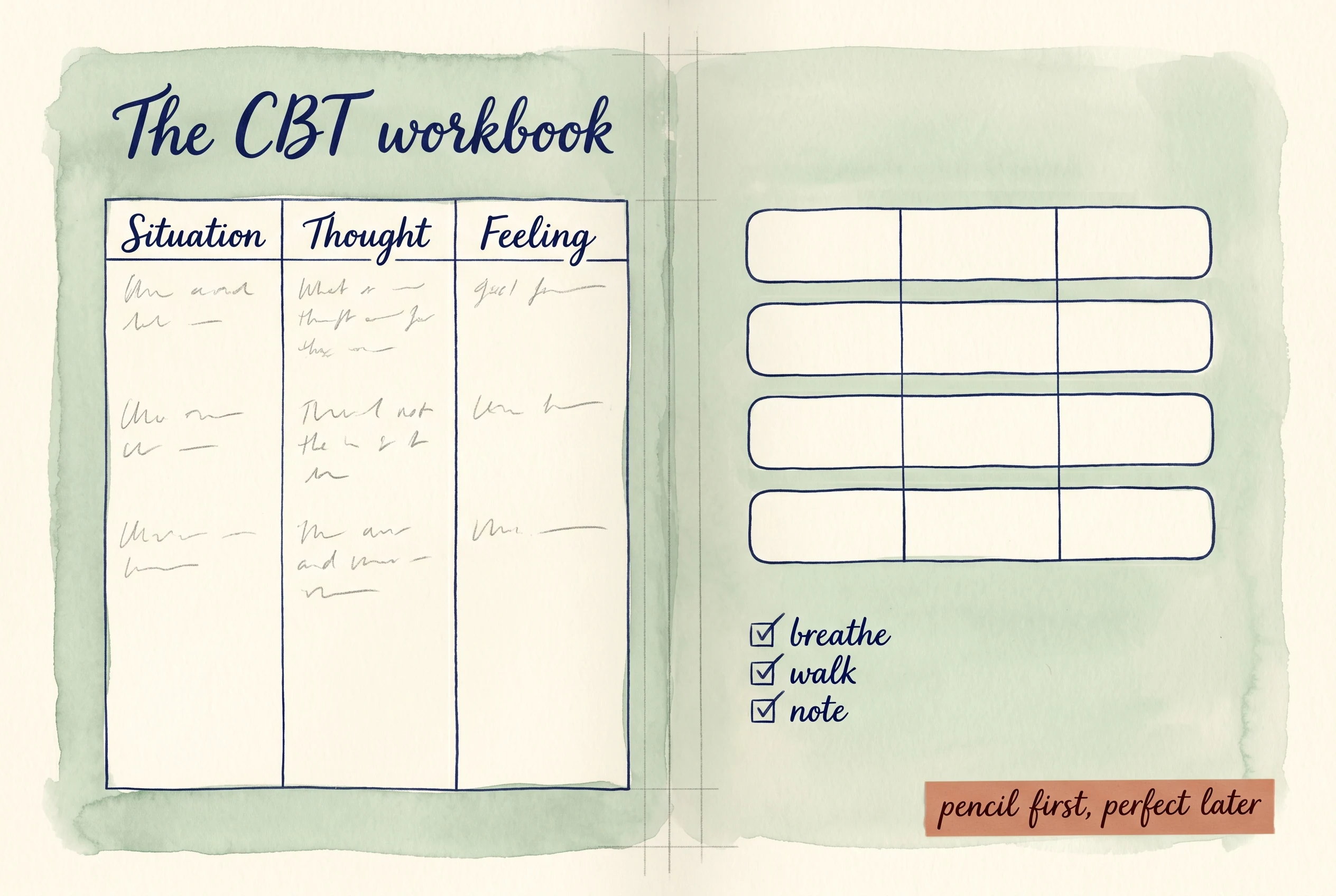
Writing down the thought, the feeling it triggered, the evidence for and against it, and a more balanced version. The signature CBT exercise.
Behavioral experiments
Testing a worried thought by trying the thing in a small way and noticing what actually happens. Belief change through real-world data.
Behavioral activation
When you feel low, the action comes before the motivation. Schedule small things, do them anyway, let momentum build from there.
Where CBT is used today
CBT was originally developed for depression. It's now the most-studied talk therapy across many situations — sometimes as the main approach, sometimes as a supplement to medication or other therapies.
- Generalized anxiety, panic, social anxiety, phobias — strongest evidence base
- Depression and persistent low mood
- Insomnia (CBT-I — the gold-standard non-drug treatment)
- Obsessive-compulsive disorder, with exposure-response prevention
- PTSD (TF-CBT, with a trauma-trained clinician)
- Eating disorders, especially bulimia and binge patterns (CBT-E)
- Anger and irritability
- Health anxiety and chronic-pain coping
- Adult ADHD-related cognitive patterns (as a supplement)
The five books
-
- Best for
- Your first CBT book when you're not yet sure what's wrong.
- Skip if
- Readers who want a 7-day quick fix — the work is gradual.
- Structure
- 19 chapters; thought records build on each other; self-paced.
- Evidence
- Co-authored by Christine Padesky, a major CBT educator. Trial-supported.
The most-cited starter workbook. Slightly clinical tone, very thorough.
-
- Best for
- Anxiety + low mood, in a defined 7-week plan.
- Skip if
- Readers who want long, reflective chapters — this book is brisk.
- Structure
- Week-by-week plan; short chapters; daily exercises.
- Evidence
- Author is a clinical psychologist; aligned with standard CBT.
The most accessible option for anyone bouncing off denser books.
-
- Best for
- Specific anxiety, panic, or phobia work — and a deep dive.
- Skip if
- Mood, relationships, or general low motivation as the main issue.
- Structure
- Encyclopedic; pick-and-choose; 20+ chapters across anxiety types.
- Evidence
- Long-running standard reference; updated across editions.
Best as a reference you return to, not a cover-to-cover read.
-
- Best for
- Depression-leaning patterns and harsh inner-critic work.
- Skip if
- Readers turned off by older language and 1980s research framing.
- Structure
- Chapter-driven; cognitive-distortion focus; long.
- Evidence
- Burns helped popularize CBT; some examples feel dated.
Pair the cognitive-distortion chapters with a newer book for tools.
-
- Best for
- A short, broad CBT primer touching several issues at once.
- Skip if
- A single deep problem — too broad for that.
- Structure
- Around 130 pages; bite-sized exercises; surveys multiple topics.
- Evidence
- Rego is a clinical psychologist; well-aligned with current CBT.
A reasonable second pick if Mind Over Mood feels too dense.
How to actually use a CBT workbook
A CBT workbook is one of the most useful things you can buy for working through anxious thinking and low mood — when you actually use it well. These five practices are how to make sure you do.
-
Pace yourself
One chapter or one technique per week is a realistic rhythm. Faster than that usually means you're reading instead of practising.
-
Write the exercises down
Thought records aren't useful in your head. CBT changes things on the page — the chapter you've highlighted does almost nothing.
-
Pick the technique that fits today
If anxious thinking is loud, start with thought records. If you can't get yourself to do anything, start with behavioral activation. You don't have to go in order.
-
Track patterns over weeks
CBT shows up as trends, not single sessions. The fourth thought record reveals what the first one couldn't.
-
Don't do it alone if you can help it
Workbook plus a clinician, a friend, or just a regular conversation about what you're learning has the best track record. Pure-solo use is where most people stall.
Free CBT resources worth using
- CCI workbooks (Centre for Clinical Interventions, Australia) Government-funded, written by clinical psychologists. Covers anxiety, depression, low self-esteem, perfectionism, panic, and procrastination. The single most reliable free resource.
- NHS self-help guides Northumberland, Tyne & Wear NHS Foundation Trust. Plain-English self-help PDFs (anxiety, depression, abuse, OCD). UK-flavoured; the CBT framing is universal.
- Therapist Aid worksheets Free worksheets used widely by clinicians. Worksheets aren't a workbook — best as a supplement to a structured book or to therapy.
Common questions
Can I do a CBT workbook on my own, without a therapist?
Yes, for mild-to-moderate anxiety and low mood — that's what these books are designed for, and the research on guided self-help backs it for those situations. A workbook is less likely to be enough on its own if the issue is severe, if you've tried self-help before and stalled, or if there's trauma involved. If you're not sure which side of that line you're on, a few sessions with a therapist alongside the workbook is the safer combination.
Do CBT workbooks actually work?
Self-guided CBT has reasonable evidence for mild-to-moderate anxiety and depression, especially when paired with brief professional contact. The honest answer: workbooks help most when you already know roughly what's going on and you can stick to a weekly rhythm. They help less when the issue is unclear or severe.
Should I read the book first or do the exercises along the way?
Do the exercises along the way. CBT is a practice, not a theory. Reading a thought-record chapter without writing one is the most common reason people stop halfway through.
Are the Amazon CBT workbooks at the top of the search results good?
Some are; many are reprints of public-domain material with new covers. Stick to books with a named clinical-psychologist author, a publisher you recognise, and an edition history. The five above all clear that bar.

Reviewed by
Antonia Moosmann
Psychologist in Germany, M.Sc. Clinical Psychology. Picks the workbooks she'd put in front of a real client.
Read Antonia's profile