Key facts
In a hurry? Here's the short version.
- For meditation: Headspace — clean structured courses with named teachers.
- For sleep: Calm — sleep stories and bedtime audio.
- For free CBT-style prompts: Woebot — daily chatbot, no paywall.
- For AI + an optional human: Wysa — free core app with a paid coach tier.
- For the largest free library: Insight Timer — most content with no subscription.
- Skip an app entirely if you're in active crisis, working through trauma, or want clinical care — see the safety note further down.
What's a mental health app?
A daily-use tool, usually 5–15 minutes per session, designed to support some piece of your mental health: meditation, sleep, mood tracking, breathing, or CBT-style prompts. Most are subscription-based; a few have generous free tiers.
The better-known apps now have peer-reviewed research behind them for specific use cases (Headspace for stress, Calm for sleep, Woebot for low mood). The honest framing: apps are a useful daily layer on top of other care — not a replacement for therapy, not a diagnosis tool, and not a crisis resource.
The right app depends less on which one is "best" and more on what you actually need: a habit, a quieter mind, better sleep, or a place to write a thought down.
How I picked these
The store is full of mental health apps. Most are not worth the subscription. Four filters let me cut the long list quickly.
-
Has it been studied?
I look for at least one peer-reviewed study on the app, ideally a randomized trial. Not a marketing whitepaper. Not a self-funded review. A real publication.
-
Is the method recognisable?
The exercises should map onto a known approach — CBT, DBT, mindfulness, sleep hygiene. If I can't tell what it's actually teaching, I skip it.
-
Is the price honest?
Public pricing on the website, no dark patterns at checkout, easy cancellation, working free trial. Vague 'in-app pricing' usually hides subscription traps.
-
Does it know its limits?
Good apps say plainly: this is not therapy, this is not a crisis tool, here's where to go if you need more. Apps that quietly imply otherwise are off the list.
The four kinds of apps
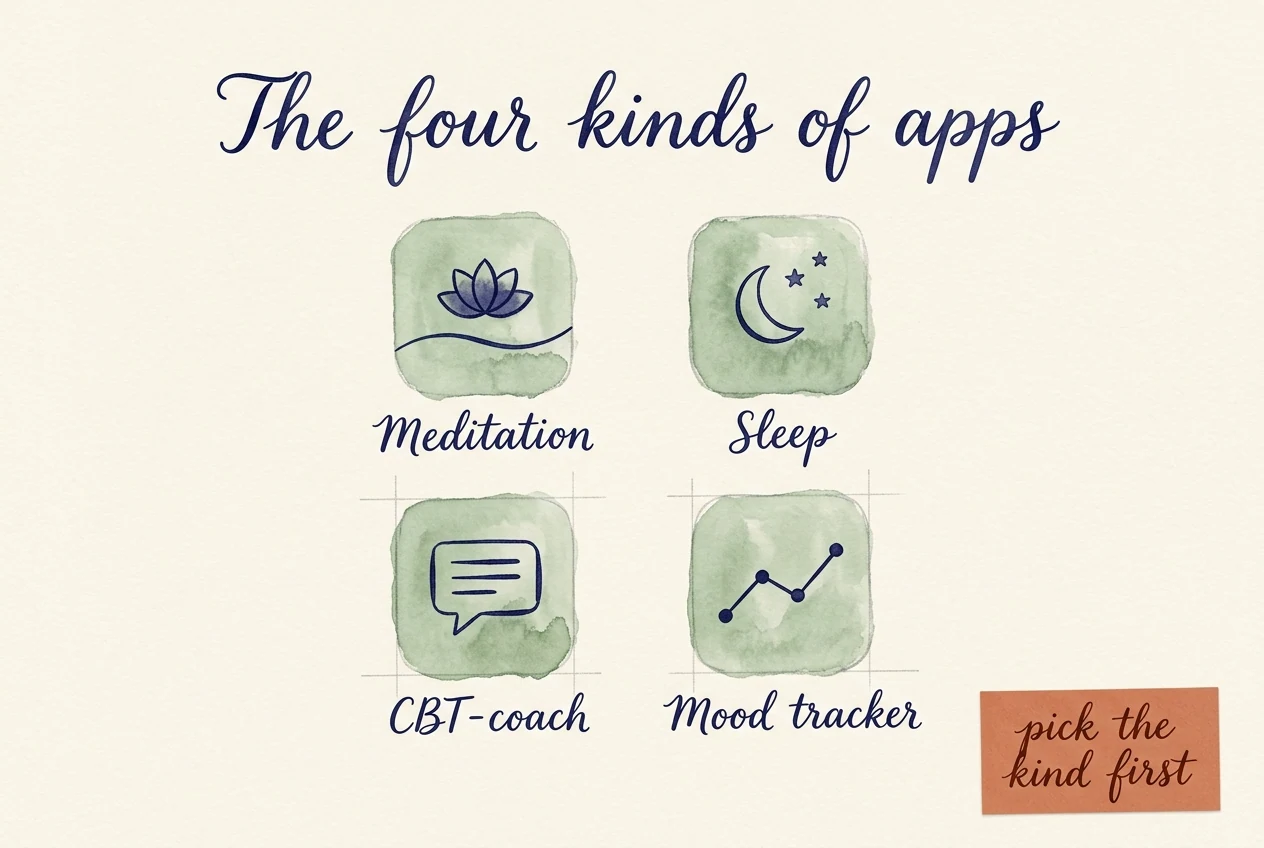
Most mental health apps fall into one of four categories. Pick the category before you pick the app.
Meditation apps
Guided audio practices, courses, and breathwork. Best for building a daily mindfulness habit, managing stress, or learning meditation from scratch.
Sleep apps
Sleep stories, soundscapes, and bedtime routines. Useful when your specific problem is falling asleep, staying asleep, or winding down before bed.
CBT-style chatbots
AI conversations using cognitive techniques — noticing thoughts, testing them, brief skill exercises. A daily prompt, not a therapist.
Mood + symptom trackers
Daily logs that build patterns over weeks. Useful data to bring into therapy, or a way to notice what's actually changing.
Where the best therapy apps actually help
Apps are good at certain things and bad at others. They earn their place when the goal is a daily layer, not a treatment.
- Building a daily mindfulness habit (5–15 minutes)
- Falling asleep and staying asleep
- Daily mood tracking — useful data to bring into therapy
- Brief CBT-style check-ins between therapy sessions
- Stress management — short breathwork, soundscapes
- Anxiety in the moment — grounding exercises
- Bedtime wind-down routines
- Learning meditation when classes aren't accessible
- Light support between therapy sessions
The five apps
-
Best for meditation
Headspace
Structured meditation courses
- Best for
- Building a meditation habit with named teachers and a clear learning arc — stress, focus, sleep, anxiety.
- Skip if
- Unguided silent meditation, free-tier diehards, or readers who already have a sleep-stories habit on Calm.
- Pricing
- $69.99/year or $12.99/month. Free trial; family + student pricing.
- Format
- iOS, Android, web. Guided audio, sleepcasts, focus sessions, courses with progress tracking.
- Evidence
- Several peer-reviewed studies; randomized trials on stress and focus, including a workplace-stress trial published in JAMA Internal Medicine (2019).
The 'Basics' onboarding pack is one of the cleanest entry points to meditation in any app.
-
Best for sleep
Calm
Sleep stories and bedtime audio
- Best for
- Falling or staying asleep — narrated sleep stories, soundscapes, slow-paced bedtime content.
- Skip if
- Anyone whose specific issue isn't sleep, or readers who want a structured meditation curriculum.
- Pricing
- $69.99/year (Calm Premium). 7-day free trial; lifetime option at higher one-time price.
- Format
- iOS, Android, web. Sleep stories, meditations, music, masterclasses.
- Evidence
- Randomized trial in college students showed sleep-quality improvement (Huberty et al., 2019). Effects are modest, real, and bound to consistent use.
The sleep stories alone earn it the slot. Outside of bedtime, the experience feels less focused than Headspace's courses.
-
Free CBT chatbot
Woebot
Conversational CBT prompts
- Best for
- A 5-minute daily check-in with CBT-style and behavioural-activation prompts. Free at the time of writing.
- Skip if
- Anyone in crisis, working through trauma, or who wants real human therapist contact.
- Pricing
- Free for general consumer users. Some employer/health-plan integrations exist.
- Format
- iOS, Android. Text chat with a CBT-style bot, mood check-ins, brief skill exercises.
- Evidence
- Stanford-authored randomized trial showed reduction in depressive symptoms in college students (Fitzpatrick et al., 2017). The app explicitly says it is not therapy.
Designed with clinical input. Useful as a daily practice prompt — not a clinician.
-
AI + human option
Wysa
AI coach with optional human therapist
- Best for
- Stress, sleep, low mood — more depth than a meditation app, less commitment than therapy. Add a human coach if needed.
- Skip if
- A meditation-first experience, anyone needing licensed therapy, or readers uncomfortable with AI handling reflection prompts.
- Pricing
- Free core app. Wysa Premium and Coach plans add features and human support — current pricing in-app.
- Format
- iOS, Android. AI chat with CBT, dialectical, and mindfulness exercises. Optional human-coach tier.
- Evidence
- Multiple peer-reviewed studies — chronic pain (JMIR mHealth, 2020), low mood, and antenatal depression. Not a regulated medical device for most uses.
One of the most-studied mental health chatbots. The free tier is genuinely usable on its own.
-

Largest free library
Insight Timer
Free meditation library + community
- Best for
- A huge free library of guided meditations, sleep tracks, yoga nidra, and live sessions across many traditions.
- Skip if
- Readers who prefer a tightly curated learning arc — Insight Timer is more 'library' than 'course'.
- Pricing
- Free for the bulk of content. Member Plus from ~$60/year adds offline downloads and structured courses.
- Format
- iOS, Android, web. Audio meditations, sleep tracks, music, live sessions.
- Evidence
- Less peer-reviewed research than Headspace or Calm. The strength is breadth and clinician-edited content; pick a teacher whose framing fits.
The most generous free tier of any major mindfulness app. Quality varies by teacher — explore a few before committing.
What I considered but didn't include
Five spots. The other apps that came close — and why they didn't make this list.
- BetterHelp / Talkspace These are therapy platforms, not apps in the daily-use sense. They live on the online-therapy comparison page.
- Sanvello Solid CBT-style mood tracking, but the experience leans heavily on a paid tier and the free tier is thinner than Woebot's.
- Replika AI companion app, marketed at times for mental health. The therapeutic claims are too soft for a clinical reviewer to vouch for, and the model has changed direction repeatedly.
- Aura, Balance, Buddhify All competent meditation apps. Headspace and Calm cover the same ground with more research behind them; adding more in this category would dilute the picks, not improve them.
How to actually use a mental health app
Downloading the app is the easy part. These five practices are the difference between a daily habit and a forgotten subscription.
-
Pick one and stick with it for 30 days
App-switching is the single most common failure mode. Whichever you choose, give it a real four weeks before deciding it isn't working.
-
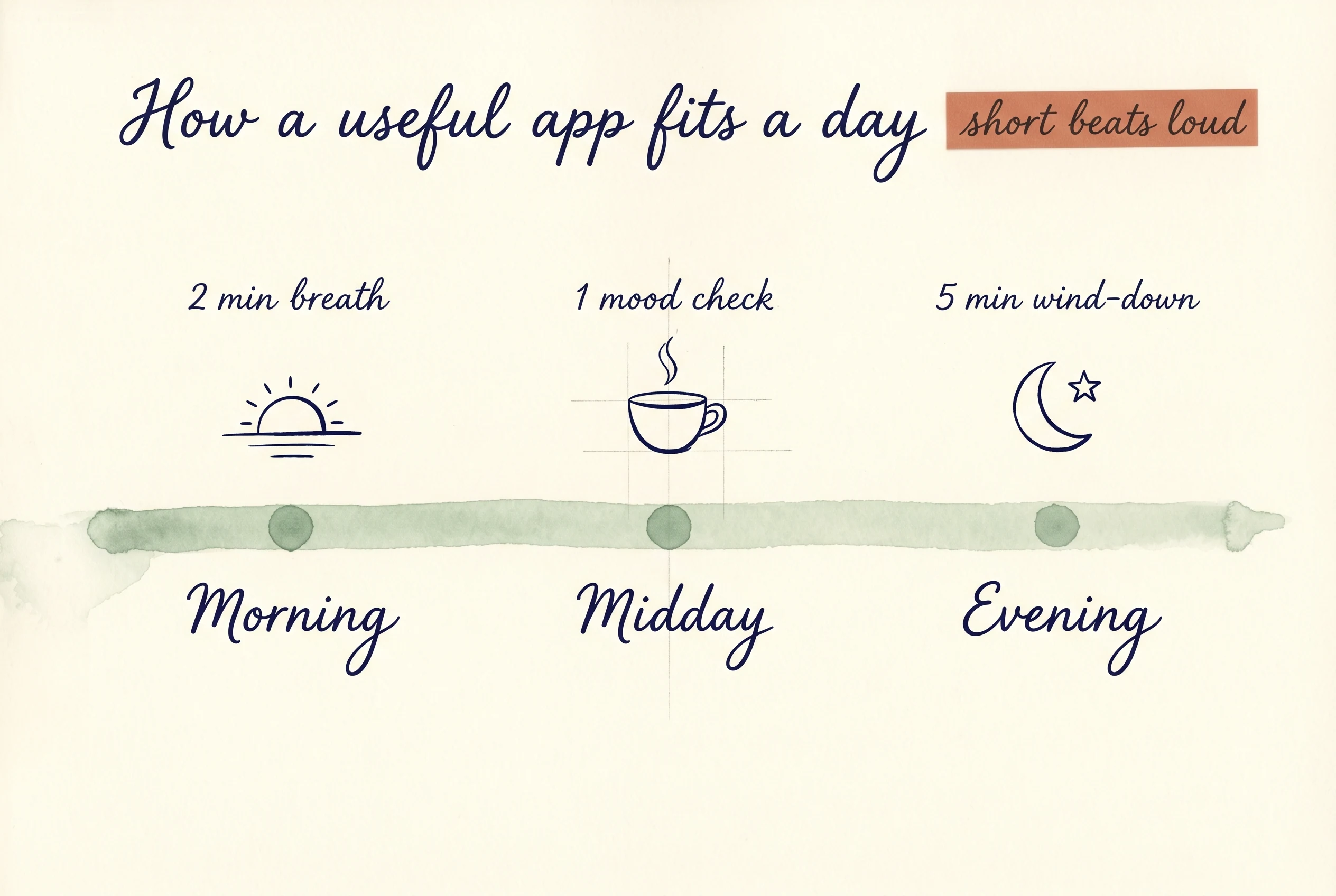
Schedule it into a real time slot
Same time every day beats 'when I have time.' Right after coffee, right before bed, or during a commute — pick one and protect it.
-
Don't pay for premium until you've used the free tier
Many people pay for a year, use the app for two weeks, then churn. Use the free trial fully before committing — most apps reveal their real fit in week three, not week one.
-
Pair it with something physical
Tying the app to a daily anchor — making coffee, brushing teeth, getting into bed — gets it into your routine far faster than willpower will.
-
Notice if it's actually working
If your sleep, mood, or anxiety hasn't shifted noticeably after four to six weeks, the app probably isn't the right tool. That's information, not failure.
Free options worth using
- Insight Timer (free tier) Tens of thousands of free guided meditations. The most generous no-cost option in the category.
- UCLA Mindful Free guided meditations from UCLA's Mindful Awareness Research Center. Clean, evidence-led, non-commercial.
- NHS Apps Library UK-curated catalogue of mental health apps with cost and research notes. Useful for sorting research-backed apps from marketing claims.
Common questions
Are mental health apps actually evidence-based?
The bigger ones — Headspace, Calm, Woebot, Wysa — have peer-reviewed research behind them for specific use cases. The research is real, but narrower than most marketing implies: studies usually look at stress, mild anxiety, or sleep, not at clinical depression or trauma. Treat "evidence-based" as "shown to help with X under study conditions," not "treats your condition."
Will an app replace therapy?
No, and the better apps say so themselves. Apps are practice and support — a daily layer that complements other care. For mild-to-moderate symptoms, an app plus periodic check-ins with a therapist is a reasonable middle path. For severe symptoms, crisis, or trauma, an app is not enough.
What's the difference between a meditation app and a CBT chatbot?
A meditation app teaches you to pay attention — guided audio, breathing, body-scan practice. A CBT chatbot prompts you to notice and challenge thoughts — a daily conversation more than a meditation. They serve different goals; you can use both. If anxious thinking is loud, a chatbot fits better. If your mind won't slow down, meditation fits better.
How do I know if an app is working?
Give it four to six weeks of consistent use, then check three things: are you sleeping better, is the thing you wanted help with slightly easier, and are you actually opening the app most days? If two of three are no, it's not the right app — or not the right tool. Switch or stop, but don't keep paying out of inertia.

Reviewed by
Antonia Moosmann
Psychologist in Germany, M.Sc. Clinical Psychology. Picks the apps she'd put in front of a real client.
Read Antonia's profile