Key facts
In a hurry? Here's the short version.
- Try journal prompts if you write better than you talk, want to catch patterns over weeks, or have a quiet five-to-fifteen minutes most days.
- Skip if writing consistently makes you feel worse (it can — see the FAQ), or you're in active crisis. If you're in danger, call or text 988 in the US, 111 in the UK, or Telefonseelsorge 0800 111 0 111 in Germany.
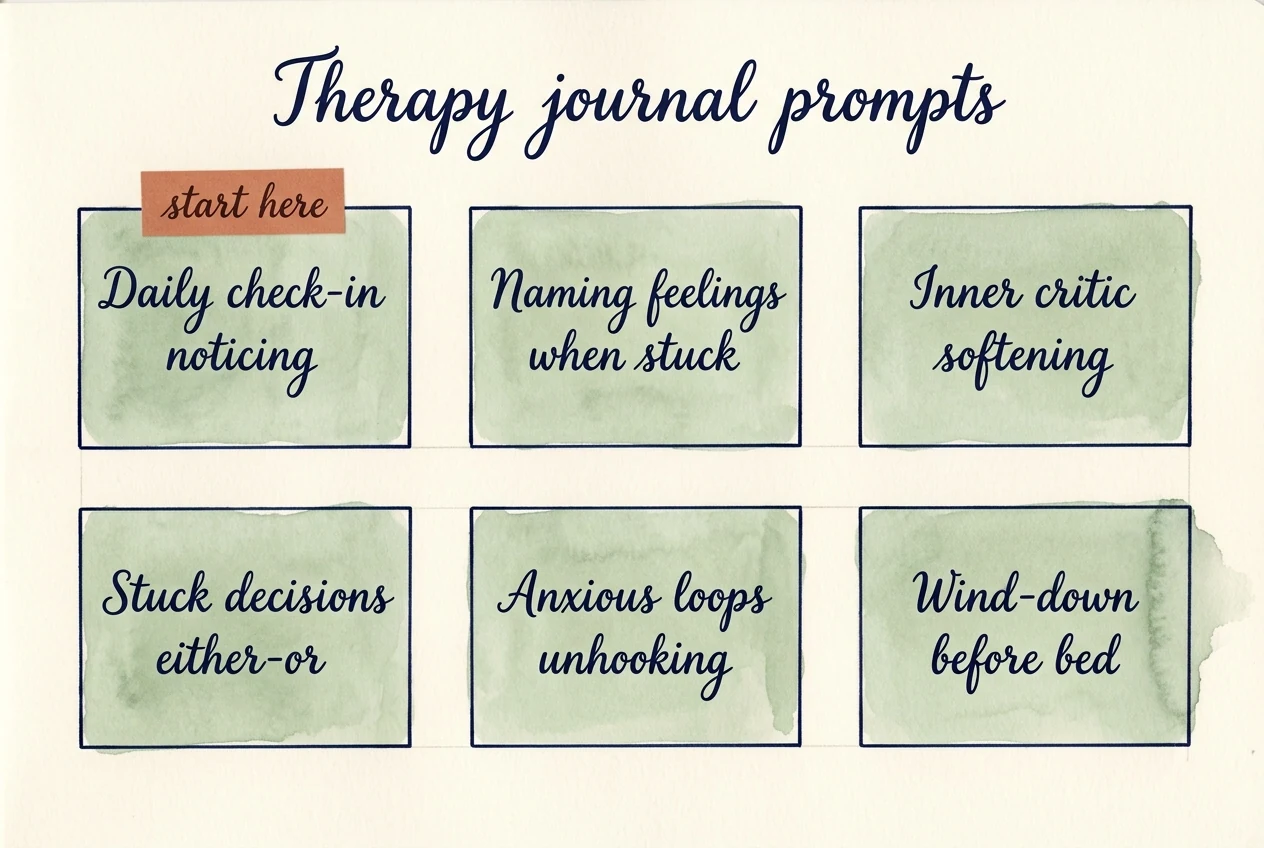
- How to use this page: the prompts below are grouped into eight situations. Pick the one that matches your day. Most readers use two or three sections, not all eight.
- Best paired with therapy sessions, a CBT workbook or DBT workbook, or just regular practice. Journaling is an adjunct, not a substitute for clinical care — if you're picking between platforms, the online therapy comparison is the buying-side companion to this page.
- Format matters less than showing up. A paper notebook, a notes app, or a dedicated therapy journal all work. The medium is much less important than the consistency.
What's a therapy journal prompt?
A therapy journal prompt is a specific question you write the answer to, rather than a blank page you stare at hoping insight arrives. Blank pages work for some people; for most, they don't. A prompt narrows the aperture and lets you start somewhere useful: a stuck decision, a conversation that's still rattling around, a feeling you can't quite name yet.
The prompts on this page aren't generic ("how are you feeling today?"). They're written for specific situations — the kinds of situations that bring readers to a page like this in the first place. Pick the section that names what's actually going on for you, and start there.
How I actually use therapy journal prompts
Five small habits that decide whether prompts do anything for you:
- Pick by your situation, not by the page order
These categories aren't a sequence. If the inner critic is loud, start there. If you're stuck on a decision, skip the rest. Most readers use two or three sections, not all eight.
- Five minutes is enough
A prompt isn't a writing exercise. Set a timer for five minutes, answer one prompt, stop. The third sentence is usually where the real answer shows up — but only if you don't pressure yourself for it.
- Write the answer that surprises you
If your first sentence is the obvious answer, keep writing. The useful answer is usually the second or third one — the one you almost edited out.
- Date the entry
Even just the day. A week of dated entries is where the pattern shows up. You won't notice the pattern from inside any single entry.
- Don't share it
A journal that another person might read becomes a performance. If you want to share something later, you can pick what to share. The unread version is where you write the real thing.
Section 1
Daily check-in prompts
When there's no specific thing you're working through, but you still want 10 minutes with yourself. The point isn't insight — it's the habit of noticing.
- What's the loudest feeling in my body right now, and where exactly do I feel it?
- What's the one small thing that's still bothering me from this morning?
- What did I do today that I wouldn't have done a year ago?
- If I had ten minutes alone tomorrow, what would I want them for?
- What's a feeling I haven't named yet today — even just the shape of it?
Section 2
When you can't name what you're feeling
Off. Heavy. Restless. Some days a feeling won't sort itself into a word. These prompts get underneath the word problem and let you describe what's actually happening.
- If this feeling were a colour, what colour, and how saturated?
- When did it start — was there a specific moment, or did it creep in?
- What was I doing right before this feeling showed up?
- Is this feeling familiar from somewhere else in my life?
- If a friend told me they felt this, what would I think they needed?
- What's the closest word I can find for it, even if it's not quite right?
Section 3
When the inner critic is loud
On a critic-loud day, the goal isn't to argue with the voice. It's to notice it clearly enough that you stop confusing its commentary with your own opinion.
- Whose voice does the critic sound like — mine, or someone else I know?
- What does the critic want me to do today? What does it want me to avoid?
- If I treated a friend the way the critic treats me today, what would I lose?
- What's a specific time recently when the critic was wrong about something?
- What's a small piece of evidence that contradicts the critic right now?
- What would I tell someone whose critic was running this loud?
Section 4
A decision you keep putting off
Stuck on a choice for weeks usually isn't about the choice — it's about a fear underneath the choice. These prompts name the fear so the decision gets smaller.
- What am I actually scared will happen if I decide either way?
- What does the future version of me, one year from now, want me to choose?
- What's the smallest version of this decision I could test before committing?
- Whose opinion am I weighting too heavily on this, and why them?
- If both options went badly, which kind of bad would I recover from faster?
- What's the cost of not deciding for another month?
Section 5
After a hard conversation
Most conversations don't get to be finished in the moment. These are for the hour afterwards, when you're still replaying it.
- What did I actually say, versus what I wanted to say?
- What did they actually mean, separate from what I heard?
- Where in my body do I still feel this conversation? What does it need?
- What's one thing I'd want them to know that I didn't say?
- Is there a follow-up I want to send, or is the silence the right call?
Section 6
Aftercare prompts (post-therapy session)
A good therapy session keeps working for hours after it ends. Writing it down catches what you'd otherwise lose by next Tuesday.
- What did my therapist say that stuck — even if it took an hour to land?
- What did I avoid bringing up today, and why?
- What did I notice in my own reaction during the session that surprised me?
- What's the homework — explicit or implied — and when am I going to do it?
- What do I want to bring back next week?
- Was there a moment of relief? What helped it land?
Section 7
When anxious thoughts loop
Loops aren't solved by more thinking. They're interrupted by writing the loop down so you can see its shape, then choosing one small action that isn't 'figure it out.'
- What's the worst-case I'm rehearsing? How likely is it, on a scale of 1 to 10, honestly?
- What's one piece of evidence that contradicts the worst-case I'm rehearsing?
- What would I do tomorrow if I knew this thought wasn't coming back?
- If a friend was rehearsing this loop with me, what would I tell them?
- What's the smallest action I can take in the next hour that doesn't involve solving the loop?
- What's an alternative outcome I'm refusing to consider?

Section 8
Wind-down and sleep prompts
Five minutes before lights-out. The point isn't insight; it's letting the day land somewhere other than the inside of your skull at 1 a.m.
- Three things from today that were finished — done, not perfect.
- One thing I'm grateful for that wasn't on a gratitude-list template.
- What can wait until tomorrow? Permission granted to leave it.
- What's the smallest worry I'm carrying into bed — and is it actually mine to solve tonight?
- What do I want tomorrow morning's first fifteen minutes to feel like?
Paper, notes app, or a dedicated therapy journal?
All three work. The medium matters less than the practice — but they have different feels.
- A plain notebook + pencil. The lowest-friction option. No subscription, no battery, no setting it up. Most people write more honestly on paper than in an app, partly because no algorithm is watching.
- A notes app on your phone. Always available, searchable later. Worse for honesty (it's the same screen you use for everything else); better for capturing a thought in the five minutes between meetings. Useful if you're already writing in your phone all day.
- A dedicated therapy journal. Books like The Anti-Anxiety Notebook or The Five Minute Journal structure the prompts for you. Helpful if open-ended pages defeat you. Look for one that doesn't make claims a therapist couldn't make. The therapy apps comparison covers a few app-based options; a full journal comparison is on the way.
Whichever you pick, the rule is the same: don't share it. A journal someone else might read becomes a performance. If you want to share something later, you can decide what to share. The unread version is where the real thing lives.
Common questions
What's a therapy journal, technically?
A journal you keep to support therapy or self-reflection — different from a daily diary. The point isn't recording what happened; it's catching what you're feeling, noticing, or avoiding. Some people use a dedicated therapy journal (Therapy Notebooks, The Anti-Anxiety Notebook, etc.); others use a plain notebook or a notes app. The format matters less than showing up.
Is this a substitute for therapy?
No. Journaling is a useful adjunct to therapy and a reasonable self-reflection tool when therapy isn't accessible — but it's not therapy. For active symptoms, persistent low mood, or anything you'd want a clinician's eyes on, the journal is the warm-up, not the answer.
How often should I journal?
Honest answer: as often as you actually will, which is usually less than you think. Two or three times a week is enough to catch patterns. Daily is great if you can hold it without making it another task to feel guilty about. Sporadic is fine.
What if writing makes things worse?
Some people spiral when they journal — the writing becomes a rehearsal of the worry rather than a release of it. If that's you, two adjustments help: a strict five-minute timer (so it stays a check-in, not a deep-dive), and pairing prompts with a closing question ("and what's one small thing I can do in the next hour"). If journaling consistently makes you feel worse, it's a wrong-tool signal — try a different intervention, or talk to a therapist.

Reviewed by
Antonia Moosmann
Psychologist in Germany, M.Sc. Clinical Psychology. I write the prompts I'd hand a client at session two — specific, situation-grouped, and short enough to actually use.
Read more about how I review