
Reviewed by
Antonia Moosmann
Psychologist in Germany, M.Sc. Clinical Psychology. I review platforms the way I'd evaluate them for a real client — evidence, fit, limits, and the parts that don't make the marketing.
Read more about how I reviewKey facts
In a hurry? Here's the short version.
- Try BetterHelp if you want licensed weekly therapy, fast match, flexible format (video / phone / chat), and you can afford ~$260–$400/month out of pocket.
- Skip it if you need a specific named therapist, direct insurance billing, medication management, or in-person sessions.
- Pricing in 2026: $260–$400/month, billed every four weeks (so 13 cycles per year, not 12). Some insurance accepted as of January 2026 — confirm with your plan.
- Privacy: 2023 FTC settlement ($7.8M) for sharing sensitive data with Meta/Snapchat. Now under a comprehensive privacy programme with third-party audits.
- Best alternative if cost is the issue: Open Path Collective or your employer's EAP. See the free alternatives section below.
- Not a crisis tool. If you're in danger, call or text 988 in the US, 111 in the UK, or Telefonseelsorge 0800 111 0 111 in Germany.
Visit BetterHelp Affiliate link
What is BetterHelp?
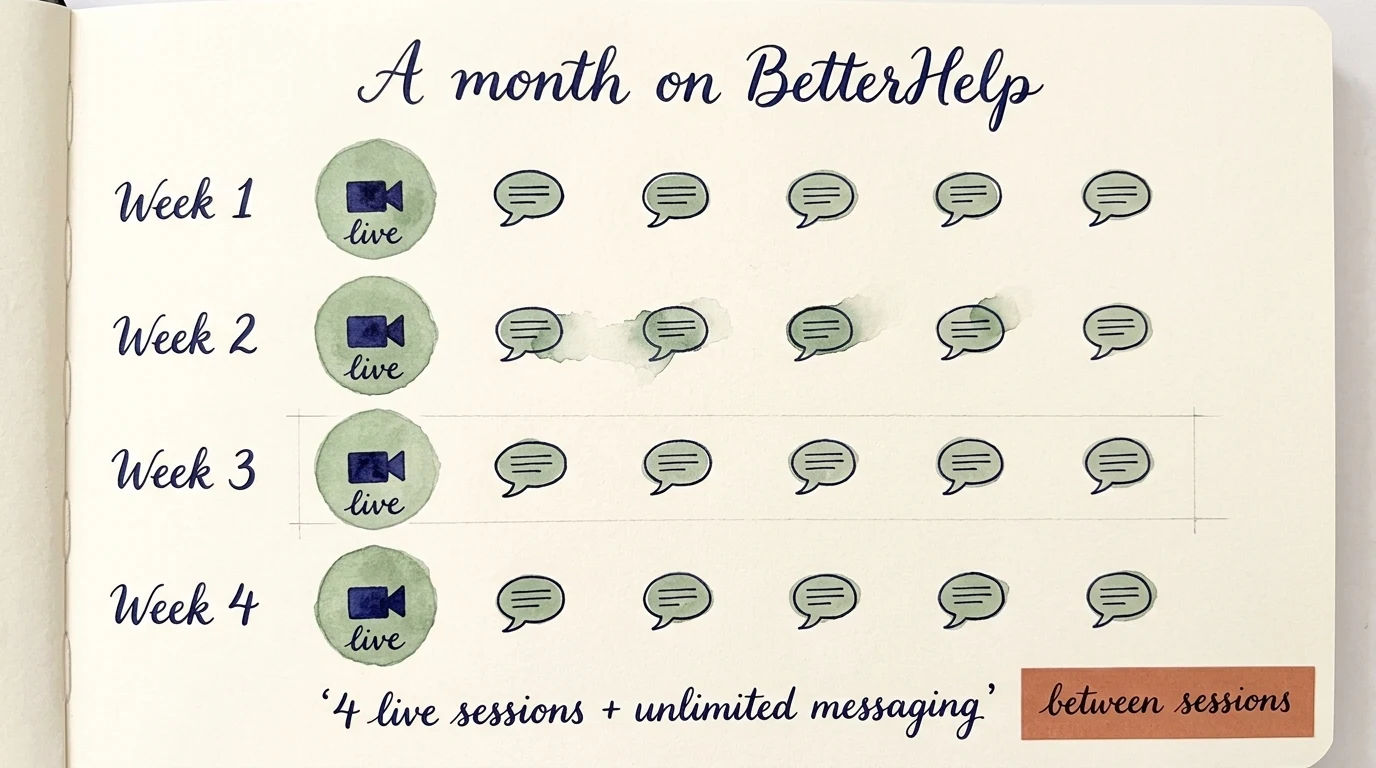
BetterHelp is the largest online therapy platform in the US — a subscription service that matches you with a licensed therapist, schedules one weekly live session (video, phone, or live chat), and gives you a messaging inbox to use between sessions.
The company was founded in 2013 by Alon Matas and Danny Bragonier and acquired by Teladoc Health in 2015. It's now the largest single online therapy network in the world, with a clinician base in the tens of thousands and several million people served to date. The scale matters: it's what makes the fast match possible, and it's also what makes the platform's design decisions — pricing, privacy, support — feel less personal than a small private practice. Therapists are independently licensed and verified before joining; BetterHelp itself does not provide the clinical care, it's the platform between you and the clinician.
For people who'd otherwise stall on finding a therapist — booking a first session is famously the hardest part — the platform's biggest design win is removing friction. The trade-off is the things you give up by skipping the directory search: you can't pick a specific named clinician before paying, you can't see their reviews, and the format is built around weekly sessions rather than the cadence you might choose with a local therapist.
How I evaluated it
Four criteria. The same ones I use for any platform I'd consider recommending.
-
Credentialed clinicians
Every clinician on the platform must be a licensed therapist in the state where they practice. I checked that the verification process is real and confirmed by the FTC settlement disclosures.
-
Evidence + clinical fit
Online talk therapy via video has roughly comparable outcomes to in-person care for mild-to-moderate anxiety and depression, per meta-analyses. BetterHelp fits that evidence band — not severe diagnoses, not crisis.
-
Transparent pricing
Public pricing is visible without signing up. No bait-and-switch on the basic tier. The four-week billing cycle is the one place to double-check the maths.
-
Privacy and data handling
After the FTC settlement, BetterHelp's privacy commitments are documented and enforceable. That's a higher bar than most consumer telehealth, even if the reason for the bar is unflattering.
My verdict
A genuinely useful platform for the right reader — but read the privacy history.
BetterHelp is the easiest version of an online therapy session to start. For mild-to-moderate anxiety, low mood, life transitions, or stuck patterns where weekly conversation with a licensed clinician is the right tool, it delivers what it advertises and the design genuinely lowers the barrier to getting help. The honest caveats are the privacy history, the subscription model, and the fact that you can't pre-pick a clinician. None of those are dealbreakers for most readers — but they should be the reasons you choose it, not surprises after you sign up.
What it does well
-
A large pool of licensed therapists
BetterHelp has one of the biggest US therapist networks in online care. Credentials are verified before onboarding, and most people get an initial match within a day or two.
-
Flexible session formats
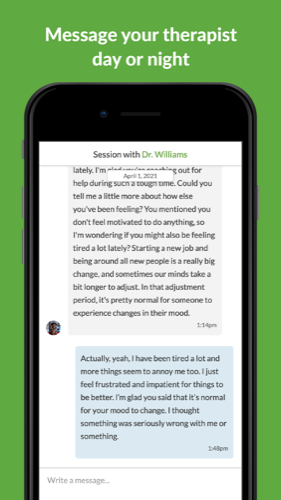
Weekly live sessions can be video, phone, or live chat — your call. Between sessions, you can message your therapist in a shared inbox and they typically reply within a working day.
-
Easy to switch therapists
You can change therapists at any time from inside the app, no awkward conversation needed. For a platform this size, the switch flow is one of the better-designed parts.
-
A real continuity layer between sessions
The journaling, worksheets, and optional group sessions aren't replacements for the live session, but they give you somewhere to put what came up during the week. Most platforms don't offer this.
-
Genuine evening and weekend coverage
The network is large enough that finding a therapist who can hold a 7pm or Saturday-morning slot is usually realistic — not always with your first match, but with the second. For people who can't take time out of a workday, that scheduling depth is more valuable than the marketing makes it sound.
Where it's limited
-
Insurance still doesn't cover most users
BetterHelp began accepting some insurance plans in January 2026, but the practical reality for most readers is still out-of-pocket monthly. Confirm with your specific plan before counting on it.
-
You can't pick a specific therapist before you pay
The matching algorithm picks for you based on the intake form. You can switch after, but you can't browse named clinicians the way you would on Psychology Today.
-
The 2023 FTC settlement
In 2023, BetterHelp paid $7.8 million in a settlement after the FTC found it had shared sensitive health information with Meta and Snapchat for advertising. The company has since been required to adopt a comprehensive privacy programme; it's a real history to know before signing up.
-
Billing every four weeks, not monthly
BetterHelp charges every four weeks, which works out to 13 billing cycles per year rather than 12. Worth noticing if you're budgeting monthly.
-
Customer support can be slow
Independent reviews have found that roughly 43% of users who contacted customer support waited more than two days for a response. Most issues are eventually resolved, but if you need fast administrative help — pausing a plan, fixing a charge, switching urgently — the wait can be a real friction point.
Pricing and access
| Weekly price | $65–$100, depending on location, preferences, and current discount |
|---|---|
| Monthly cost (real) | $260–$400, billed every 4 weeks — that's 13 cycles a year, not 12 |
| Insurance | Some plans accepted from Jan 2026; varies by plan, state, clinician. Confirm before signing up. |
| Cancellation | From account settings. Takes effect at the end of the current 4-week cycle — not instant. |
| Outside the US | Operates in UK, CA, AU and parts of the EU. Therapist availability is much thinner. |
BetterHelp also runs specialised verticals at similar prices — BetterHelp Couples, Faithful Counseling, Pride Counseling, and Teen Counseling (with parental consent in the US). Same billing rhythm, same clinical model; the intake routes you to a clinician trained for that specific fit. If one of those pathways is your actual reason for considering the platform, sign up through that vertical rather than the general intake.
How BetterHelp compares to the alternatives
Four platforms cover most of the online-therapy market. Here's where BetterHelp fits — its column is highlighted.
| Dimension | BetterHelp | Talkspace | Online-Therapy.com | Brightside |
|---|---|---|---|---|
| Best for | Out-of-pocket weekly therapy, fast match | Insurance + psychiatry combo | Structured CBT program | Therapy + medication coordinated |
| Starting price (cash) | $65–$100/week | $69–$109/week | $48/week (Basic, no live sessions) | $95/mo psychiatry · $299/mo therapy · $349/mo combined |
| Insurance | Limited (some plans Jan 2026) | Broad in-network — Aetna, Cigna, BCBS, UHC, Medicare | None — superbills for out-of-network only | Broad incl. Medicaid (~55M reach) |
| Psychiatry | No prescribing | Yes — non-controlled meds, separate plan | No prescribing | Yes — PrecisionRx, non-controlled meds |
| Crisis program | No | No | No | Crisis Care — CAMS-based, 4–12 weeks |
| Privacy track record | 2023 FTC settlement ($7.8M) | 2020 NYT report + 2024 TikTok class action | Clean — no lawsuits in 16 years | Clean — no known privacy issues |
| Where to skip | Insurance-needed, psychiatry-needed | International, controlled medications | Insurance-needed, non-CBT modalities | Therapy-only readers, international |
Cross-links: Talkspace review · Online-Therapy.com review · Brightside review · Talkspace vs BetterHelp head-to-head.

How to get the most out of BetterHelp
If you do sign up, these five practices are the difference between a useful month of therapy and a subscription that quietly auto-renews.
-
Fill the intake honestly
The match algorithm uses your intake answers. Glossing over the harder stuff usually means a less-good match. Be specific about what you actually want help with.
-
Schedule the live session for a real time
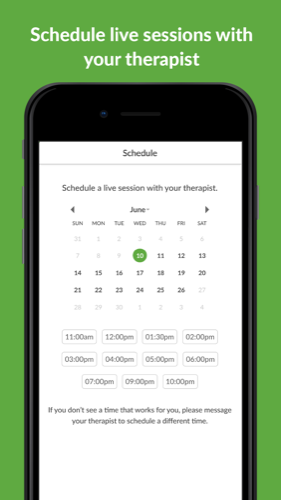
Most people who churn at week three were 'going to schedule it.' Pick a recurring slot when you book the first one, not 'sometime.'
-
Use the messaging between sessions
The asynchronous inbox is the part most users underuse. A two-line message after a session — what stuck, what didn't — gives your therapist real continuity to work with.
-
Switch if the fit isn't right by session three
Therapeutic alliance matters more than method. If by session three the conversation feels flat, switch. The switch flow is designed to be quick; use it.
-
Plan an off-ramp
BetterHelp is a subscription, not a treatment package. Know in advance what the exit looks like — pause, cancel, or shift to a local clinician — so you're not paying past the point where it's useful.
Free or cheaper alternatives
BetterHelp's price is the friction it doesn't remove. If cost is the issue, these are the three I'd point a reader to first.
- Open Path Collective US-only directory of licensed therapists offering sliding-scale sessions ($30–$80). One-time $65 membership.
- Your employer's EAP If your employer offers an Employee Assistance Program, you usually get 3–8 short-term counselling sessions free. Underused; worth asking HR.
- Community mental health centres SAMHSA's treatment locator (US) finds publicly funded community mental health centres — sliding scale or no-fee.
Common questions
Is BetterHelp actually therapy?
Yes — sessions are with licensed therapists practising under their own license, in the state where they're licensed. The therapy itself is real. The differences from in-person care are: format (video/phone/chat), session length (35–40 minutes vs. the traditional 50), and the subscription model rather than per-session billing.
Does insurance pay for BetterHelp?
For most readers in 2026: not directly. BetterHelp began accepting some plans in January 2026, but coverage varies by plan and state. Before signing up, check what your specific plan actually pays — and ask BetterHelp's intake whether your plan is one of the supported ones.
Is BetterHelp safe to share information with after the FTC issue?
The 2023 settlement banned BetterHelp from sharing sensitive health data for advertising and required a comprehensive privacy programme with regular third-party audits. The new constraints are real and enforceable. Whether the past data exposure is a dealbreaker is a personal call — knowing the history is the part that matters.
When is BetterHelp the wrong choice?
Active crisis or recent self-harm — call 988 (US) or your local crisis line first. Severe depression with safety concerns. A diagnosis that requires medication management (BetterHelp doesn't prescribe; look at Brightside or a local psychiatrist). And situations where your therapist needs in-person observation — eating-disorder treatment, complex trauma, severe dissociation.
How is BetterHelp different from Talkspace?
Two practical differences. First, insurance: Talkspace has had broader insurance partnerships in the US for longer than BetterHelp, so for a reader whose plan covers Talkspace the out-of-pocket cost can be dramatically lower. Second, psychiatry: Talkspace offers a separate medication-management plan; BetterHelp does not prescribe. Outside of those two, they're closer than most reviews make them sound — similar matching flow, similar weekly-session model, similar messaging-plus-live design. If insurance is the variable, check Talkspace first. If you want the largest therapist pool and the fastest match, BetterHelp is the better-fit answer. For the full head-to-head, see Talkspace vs BetterHelp: which one I'd pick.
Can I use BetterHelp from outside the US?
BetterHelp does match users with therapists in some other countries (UK, Canada, Australia, parts of the EU) but the clinical-licensing rules are different in each market — a therapist licensed in California can't legally practice with someone resident in Berlin, even via video. In practice this means fewer therapists available outside the US, longer initial-match times, and a higher chance that the first match isn't right. For European readers, looking at local-licensed telehealth (Instahelp in DE/AT, Selfapy for self-guided programmes, or your country's statutory mental-health system) is often the better first step.