
Reviewed by
Antonia Moosmann
Psychologist in Germany, M.Sc. Clinical Psychology. I review platforms the way I'd evaluate them for a real client — evidence, fit, limits, and the parts that don't make the marketing.
Read more about how I reviewKey facts
In a hurry? Here's the short version.
- Try Talkspace if your insurance is one of Talkspace's network partners (Aetna, Cigna, Optum, United, TRICARE, BCBS, Medicare in select states), or if you need therapy + psychiatry on the same platform.
- Skip it if your insurance isn't covered (BetterHelp is usually cheaper out of pocket), you need controlled-medication psychiatry, or you want to pick a specific named therapist before paying.
- Pricing in 2026: $69/week messaging-only · $99/week messaging + video · $109/week with workshops. Psychiatry: $299 initial / $175 follow-up cash-pay. Insurance copays $15–$30; ~⅓ pay $0.
- Privacy: 2024 TikTok data-sharing class action (active); 2020 New York Times reporting on transcript mining. Read the privacy note below before signing up.
- Best alternative if cost is the issue: Open Path Collective sliding-scale, your employer's EAP, or BetterHelp.
- Not a crisis tool. If you're in danger, call or text 988 in the US, 111 in the UK, or Telefonseelsorge 0800 111 0 111 in Germany.
Visit Talkspace Affiliate link
What is Talkspace?
Talkspace is a subscription online-therapy platform that matches you with a licensed therapist and lets you communicate through messaging, live video, or both — depending on the plan you pick. Unlike most competitors, Talkspace also offers psychiatry as a separate paid service on the same account, and accepts in-network insurance from most major US plans plus Medicare in select states.
The platform was founded in 2012 by Oren and Roni Frank and went public in 2021. It's older than BetterHelp by a year, smaller in therapist headcount, and structurally more invested in the insurance + medication angle. That positioning is the most important thing about it: Talkspace's real advantage over its peers is whether your plan is one of theirs.
How I evaluated it
Four criteria. The same ones I use for any platform I'd consider recommending.
-
Credentialed clinicians
Every Talkspace therapist must be a licensed clinician in the state where they practice. Verification happens before they join the network. I checked that the licensure model is real (it is) — the harder question is experience level, which the marketing language doesn't make obvious. Talkspace is transparent about therapist experience on individual profiles; read those before your first session.
-
Evidence + clinical fit
Messaging-based therapy has more published evidence behind it via Talkspace's research collaborations than almost any competitor — including peer-reviewed trials showing reduction in depression and anxiety symptoms. That evidence is for mild-to-moderate symptoms; it doesn't extend to severe diagnoses, active crisis, or trauma processing without a clinician's eyes.
-
Transparent pricing
Public pricing is on the website. The three tiers are clearly named. The one place to double-check is psychiatry — the $299/$175 cash-pay numbers aren't on the front-page pricing block; they're in the help center. If you're considering psychiatry, get the insurance estimate before committing.
-
Privacy and data handling
Talkspace publishes a privacy policy, runs HIPAA-compliant infrastructure, and meets the formal baseline. The harder question — whether the public website's tracking pixels and the 2020 transcript-mining reporting hold up against the trust required for therapy — is the open question this review names but doesn't pretend to settle. Read the YMYL note further down.
My verdict
The right platform for the reader whose insurance is on the list — with privacy caveats worth knowing.
Talkspace's case is specific: if your plan is one of theirs, you get licensed therapy for $0–$30 a session and the option of psychiatry on the same account. For that reader, nothing else in this category competes. For the reader paying out of pocket without psychiatry needs, BetterHelp is usually cheaper. And the 2020 transcript-mining reporting plus the active 2024 TikTok data-sharing class action are the things to read before signing up — not after. None of those are dealbreakers for most readers, but they should be the reasons you choose Talkspace, not surprises after the first month's bill.
What it does well
-
Real insurance coverage, not vapor coverage
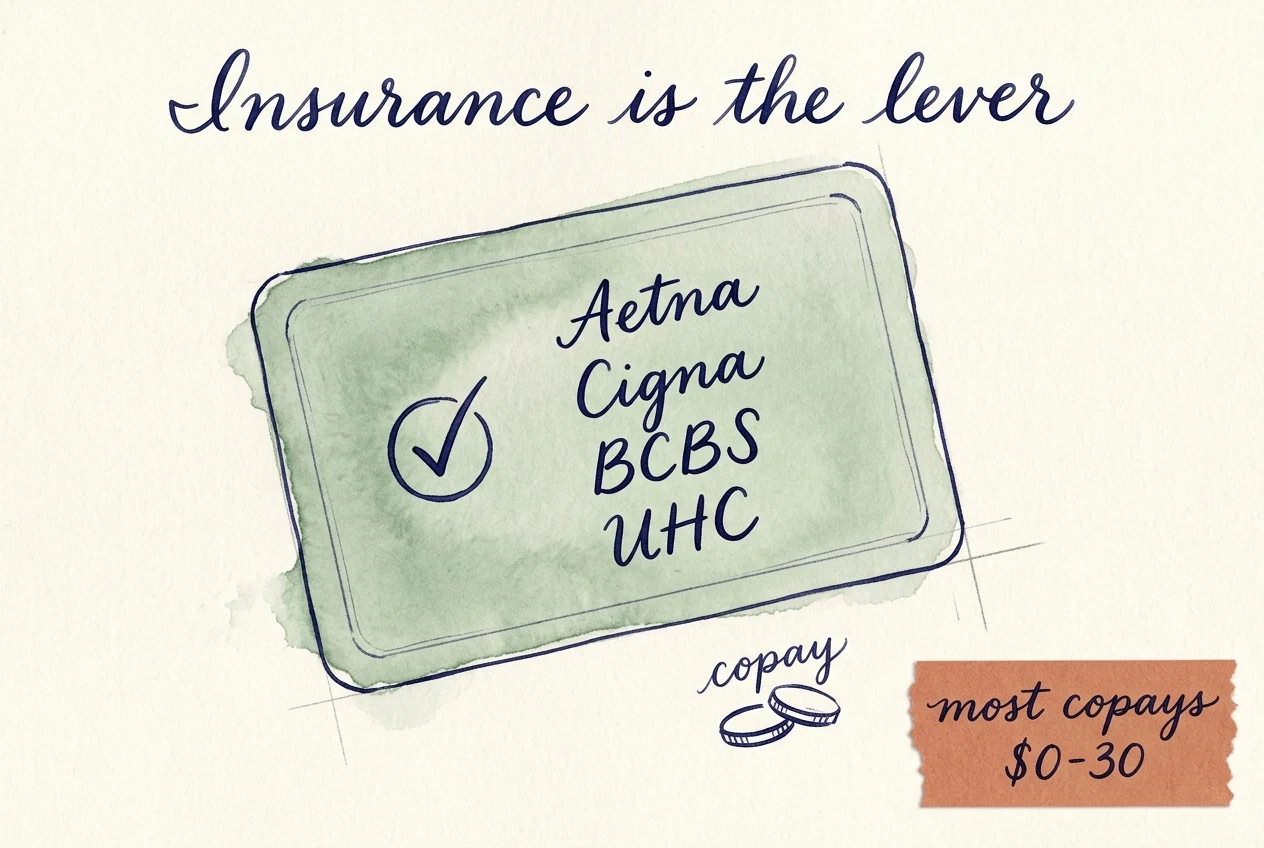
Talkspace is in-network with Aetna, Cigna, Optum, United Healthcare, TRICARE, Blue Cross Blue Shield, Medicare in select states, and many major employer plans. Average copay $15–$30 per session; nearly a third of insured users pay $0. This is the single biggest reason to pick Talkspace over BetterHelp — if your plan is one of theirs, the price gap stops being a gap.
-
Psychiatry on the same platform
You can add a psychiatric provider to the same account and have therapy + medication evaluation in one place. Most online therapy platforms don't prescribe at all. Talkspace's psychiatrists prescribe non-controlled medications via live video; controlled substances stay off the table. The integration is the convenience — you're not coordinating between two unrelated tools.
-
Three pricing tiers, including a real messaging-only option
Messaging-only at $69/week is a genuine asynchronous-therapy product — useful for readers who write better than they talk and who don't need a weekly live session. Most platforms either don't offer this or treat messaging as a side-channel to weekly video. Talkspace is one of the few where messaging is a first-class plan.
-
Published research base
30+ peer-reviewed studies with Columbia, Harvard, NYU, and others, including 2020 work in BMC Psychiatry showing remission of depression and anxiety symptoms in messaging-based therapy. The evidence is for the format Talkspace actually delivers, not a related-but-different service — meaningful and uncommon in this category.
-
Talkspace Go and structured workshops
A separate self-guided app (Talkspace Go) runs at $29.99/month with classes and therapist-led group sessions — useful as a bridge while waiting for a match, or as the only product for readers who don't yet want one-to-one therapy. The Video + Messaging + Workshops tier also adds live group sessions for $109/week.
Where it's limited
-
Therapist matching is opaque and shallow
The intake form is short and you can't browse named clinicians before paying — same friction as BetterHelp. The algorithm picks one, and the most common complaint in 2026 reviews is exactly this: the first match isn't always a good one. You can switch, but the switch flow is more cumbersome than BetterHelp's. Choose a real platform feature, not a matching guarantee.
-
The 2024 TikTok data-sharing class action
A California consumer filed a class action in August 2024 alleging Talkspace installed TikTok pixel tracking software on its public website that collected and shared visitor identity data with TikTok before the cookie banner appeared. This sits alongside earlier 2020 reporting by the New York Times that former employees said Talkspace mined anonymized session transcripts for product development. Active class actions don't equal proven guilt — but two separate, named privacy issues across five years is the pattern worth knowing about.
-
Therapist response time can lag — sometimes badly
Talkspace guarantees responses 5 days a week, but reviewers consistently note wait times can stretch beyond that during high-load periods. If you're paying for messaging therapy specifically, the response cadence is the product. Slow responses on a vulnerable message are a real friction point that the marketing language doesn't acknowledge.
-
Cash-pay psychiatry is expensive
Without insurance, psychiatric care runs $299 for the initial visit and $175 per follow-up. That's mid-range for online psychiatry but still considerable; it's the lever insurance unlocks. If you're paying out of pocket for medication management specifically, check whether a local psychiatrist with sliding-scale fees might cost less.
-
Therapist quality varies and the platform pays clinicians less than market rate
Talkspace has thousands of therapists across multiple modalities (CBT, DBT, mindfulness, psychodynamic), but the platform's pay model is below the average independent-practice rate and clinicians carry high caseloads. That has real downstream effects — newer providers, faster turnover, and clinicians who may not have the bandwidth your particular case needs. Switching therapists is part of the design here for a reason.
Pricing and access
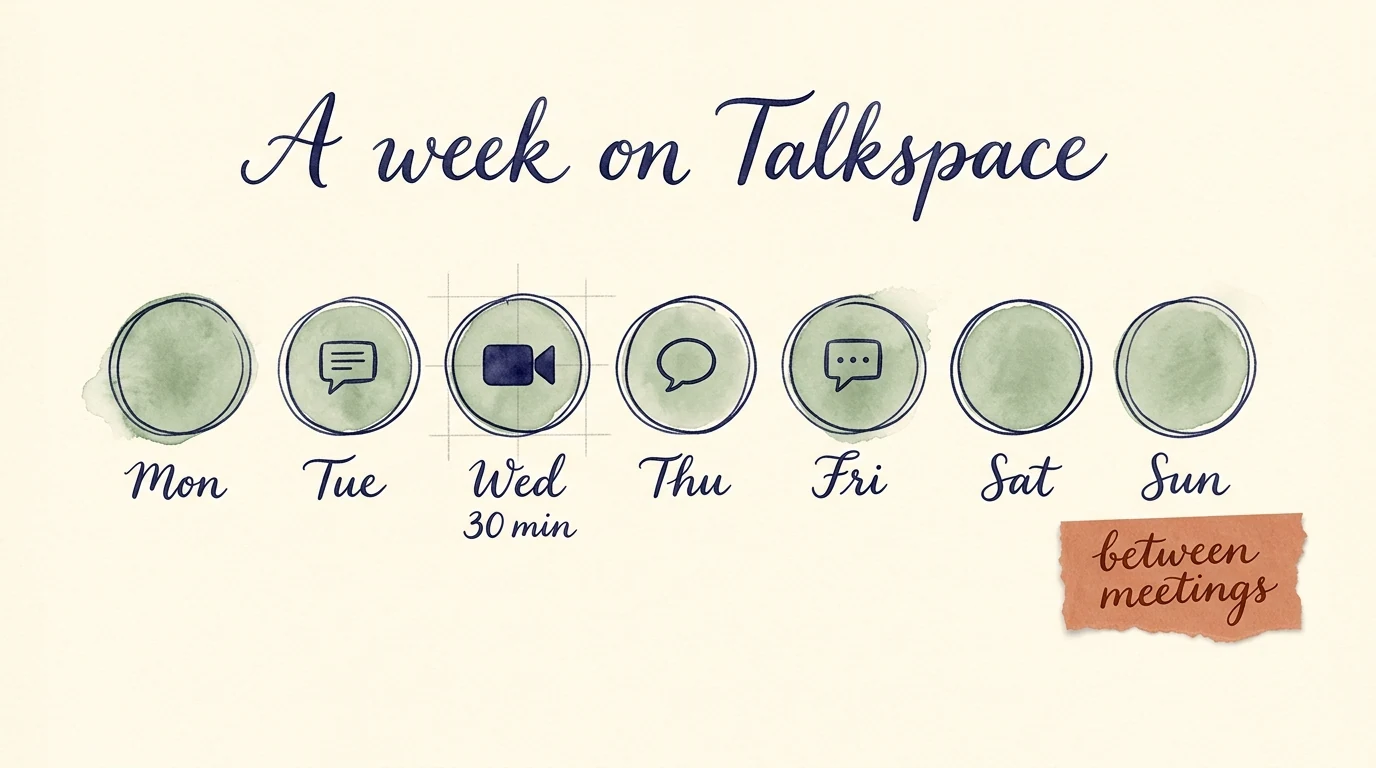
| Messaging only | $69/week — text, video, and audio messages with response 5 days/week. Billed monthly ($276/month). |
|---|---|
| Video + messaging | $99/week — four 30-minute live sessions per month plus messaging. Billed monthly ($396/month). |
| Video + messaging + workshops | $109/week — adds live therapist-led workshops. Billed monthly ($436/month). |
| Psychiatry (cash-pay) | $299 initial visit · $175 per follow-up. Non-controlled medications only. |
| With insurance | Aetna · Cigna · Optum · United · TRICARE · Blue Cross Blue Shield · Medicare (select states) · many EAPs. Average copay $15–$30; ~⅓ pay $0. |
| Medicaid | Not accepted. |
| Talkspace Go | $29.99/month after 7-day trial. Self-guided classes + therapist-led group sessions; not one-to-one therapy. |
| Cancellation | From account settings. Takes effect at the next billing date — not instant. |
| Outside the US | Limited international availability; international insurance not supported. |
The pricing case for Talkspace is the insurance case. Without insurance, the messaging tier ($276/month) is more than BetterHelp's typical $260–$400 range, and the video tier is at the top of the BetterHelp range. With insurance, Talkspace flips: a $15–$30 copay puts it well below BetterHelp for the same weekly live-session format. Run your specific plan through Talkspace's insurance estimator before deciding which platform to compare on price.
How Talkspace compares to the alternatives
Four platforms cover most of the online-therapy market. Here's where Talkspace fits — its column is highlighted.
| Dimension | BetterHelp | Talkspace | Online-Therapy.com | Brightside |
|---|---|---|---|---|
| Best for | Out-of-pocket weekly therapy, fast match | Insurance + psychiatry combo | Structured CBT program | Therapy + medication coordinated |
| Starting price (cash) | $65–$100/week | $69–$109/week | $48/week (Basic, no live sessions) | $95/mo psychiatry · $299/mo therapy · $349/mo combined |
| Insurance | Limited (some plans Jan 2026) | Broad in-network — Aetna, Cigna, BCBS, UHC, Medicare | None — superbills for out-of-network only | Broad incl. Medicaid (~55M reach) |
| Psychiatry | No prescribing | Yes — non-controlled meds, separate plan | No prescribing | Yes — PrecisionRx, non-controlled meds |
| Crisis program | No | No | No | Crisis Care — CAMS-based, 4–12 weeks |
| Privacy track record | 2023 FTC settlement ($7.8M) | 2020 NYT report + 2024 TikTok class action | Clean — no lawsuits in 16 years | Clean — no known privacy issues |
| Where to skip | Insurance-needed, psychiatry-needed | International, controlled medications | Insurance-needed, non-CBT modalities | Therapy-only readers, international |
Cross-links: BetterHelp review · Online-Therapy.com review · Brightside review · Talkspace vs BetterHelp head-to-head.
How to get the most out of Talkspace
If you do sign up, these five practices are the difference between a useful month of therapy and a subscription that quietly auto-renews.
-
Verify your insurance before paying
Talkspace's pricing case is the insurance case. Before signing up, go to your insurance member portal and confirm Talkspace is in-network for your specific plan, your specific state, and the service type you want (therapy vs psychiatry). The Talkspace intake will also estimate your copay — use both.
-
Pick the tier that matches how you communicate
If you write better than you talk, messaging-only at $69/week is a real product. If a weekly live session is non-negotiable, go straight to Video + Messaging. Don't pay for tiers you won't use; the friction of switching tiers later is small.
-
Switch therapists fast if the first match isn't right
The first-match success rate is around 83% according to user surveys — meaning roughly one in six readers will want a different clinician. Don't sit with a bad fit through four billing cycles trying to be polite. Therapeutic alliance matters more than method; if by session three the conversation feels flat, switch.
-
Use the messaging the way it's designed
Asynchronous therapy works when you actually use the inbox between sessions — a two-line note about what stuck or didn't is more useful than a long essay. The most-cited complaint about response times comes from users who treated messaging as background; the readers getting value treat it like a short ongoing conversation.
-
Check the auto-renew before your trial ends
Talkspace bills monthly. Plans auto-renew. If you want to pause, downgrade, or cancel, do it from account settings before the next billing date — not after. Customer support response times are a documented friction point; don't rely on getting a fast reply for a billing fix.
Free or cheaper alternatives
If Talkspace's pricing doesn't work for your situation — no insurance match, no employer EAP, Medicaid only — these are the three I'd point a reader to first.
- Open Path Collective A nonprofit network of clinicians offering $40–$80 sliding-scale sessions to readers who can't afford standard rates. One-time $65 lifetime membership.
- Your employer's EAP Many employers include 3–6 free counselling sessions per year through an Employee Assistance Program. Check your HR portal before paying out of pocket — sometimes these benefits go through Talkspace itself.
- Community mental health centers SAMHSA's treatment locator surfaces low-cost and sliding-scale community providers near you, including some that bill Medicaid. The intake is slower than Talkspace's but the cost can be a fraction.
Common questions
Is Talkspace covered by insurance?
Often, yes. Talkspace is in-network with Aetna, Cigna, Optum, United Healthcare, TRICARE, Blue Cross Blue Shield, and Medicare in select states. Average copay is $15–$30 per session and nearly a third of insured users have a $0 copay. The big exception is Medicaid (not accepted) and international plans (not supported). Before signing up, confirm your specific plan and state.
How is Talkspace different from BetterHelp?
Talkspace wins on insurance and offers psychiatry; BetterHelp wins on price (without insurance), financial assistance, and therapist-switching ergonomics. If your plan covers Talkspace, the cost gap usually disappears and Talkspace is the right pick. If you're paying out of pocket and don't need psychiatry, BetterHelp is usually cheaper. If you need medication management at all, Talkspace — BetterHelp doesn't prescribe, and if you want medication and therapy in a single coordinated plan with a structured crisis pathway, the Brightside Health review covers the alternative. For the full head-to-head, see Talkspace vs BetterHelp: which one I'd pick.
Can a Talkspace psychiatrist prescribe my current medication?
Probably for most non-controlled medications: SSRIs, SNRIs, mood stabilisers, non-stimulant ADHD medications, etc. Talkspace psychiatrists cannot prescribe controlled substances — stimulants for ADHD, benzodiazepines, certain sleep medications. If you're on a controlled medication, you'll need a local prescriber for that, even if you use Talkspace for everything else.
Is messaging-only therapy actually therapy?
It's therapy with a different rhythm. Peer-reviewed research on Talkspace's own format has shown reduction in depression and anxiety symptoms; it's a real evidence-supported product, not a chat app. Whether it's the right format for you depends on whether you process things in writing — for readers who do, it's often a better fit than weekly video. For readers who need real-time conversation, pick a tier that includes live sessions.
What about the privacy concerns I've seen mentioned?
Two named issues. (1) A 2020 New York Times report said former employees said Talkspace had mined anonymized session transcripts for product development. (2) An August 2024 class action lawsuit alleges Talkspace's public website installed a TikTok pixel that collected and shared visitor data before the cookie banner appeared. Active class actions aren't proven guilt — but two separate, named issues across five years is the pattern. Each reader's tolerance for that history is their own call to make.
When is Talkspace the wrong choice?
Active crisis or recent self-harm — call 988 or your local crisis line first. Severe symptoms that need higher-intensity care. A diagnosis requiring controlled-medication management. International readers outside Talkspace's coverage map. Medicaid coverage as your only option. And situations where you'd want to interview and pick a specific named clinician before paying — Talkspace's matching model doesn't let you do that.