Reviewed by
Antonia Moosmann
Psychologist in Germany, M.Sc. Clinical Psychology. I review platforms the way I'd evaluate them for a real client — evidence, fit, limits, and the parts that don't make the marketing.
Read more about how I reviewKey facts
In a hurry? Here's the short version.
- Try Brightside if you want therapy and medication on one coordinated platform, you have insurance (especially Medicaid), or you're considering a structured Crisis Care program after a recent suicide attempt or hospitalisation.
- Skip it if you only want talk therapy ($299/mo is expensive for that alone), you need controlled medications (stimulants, benzos — no online platform prescribes them), or you're outside the US.
- Pricing in 2026: Psychiatry $95/mo + Rx copay, Therapy $299/mo (4 video sessions + messaging), Combined $349/mo. With insurance, typical copay $15–$30.
- Insurance: Aetna, Cigna/Evernorth, Anthem Blue Cross, UnitedHealthcare (select states), Medicare, several Medicaid plans, TRICARE — roughly 55M people covered.
- Crisis Care: CAMS-based, 4–12 week structured program for elevated suicide risk. 77% elimination of suicidal ideation within 12 weeks per published outcomes.
- If you're in danger right now, call or text 988 in the US, 111 in the UK, or Telefonseelsorge 0800 111 0 111 in Germany. Crisis Care is the next-day step, not the right-now one.
Visit Brightside Health Affiliate link
What is Brightside Health?
Brightside Health is a US-only online platform that offers three services on one account: psychiatric prescribing, weekly therapy, and a separate structured Crisis Care program for people at elevated suicide risk. Unlike most consumer telehealth — which started as a therapist marketplace and bolted on psychiatry — Brightside was built psychiatry-first and added therapy alongside it. That heritage shows up in the coordinated care, the published outcome data, and the PrecisionRx prescribing engine.
The PrecisionRx prescribing engine analyses 100+ data points per patient against a library of 1,000+ medication/dosage combinations and surfaces the most likely match to the psychiatric provider before they prescribe. Published outcomes show 69% first-time prescription success — meaningful in a field where the standard pattern is "try one, try another, try a third." The approach is documented in a peer-reviewed BMC Psychiatry feasibility paper; it's real clinical decision support, not a marketing claim.
The Crisis Care program, launched in December 2022, is the part of Brightside that has no real equivalent on BetterHelp, Talkspace, or Online-Therapy.com. Built around the Collaborative Assessment and Management of Suicidality (CAMS) framework, staffed only by CAMS-trained clinicians, with weekly video sessions and 24/7 call support, it's the rare consumer-telehealth program designed for the specific population most platforms route away.
How I evaluated it
Four criteria. The same ones I use for any platform I'd consider recommending.
-
Credentialed clinicians
Therapists are licensed in the state where they practise, and psychiatric providers are board-certified MDs, NPs, or PAs licensed to prescribe. Crisis Care clinicians are additionally CAMS-trained — a real, named certification rather than internal-only credentialing. 85% therapy satisfaction and 87% psychiatry satisfaction per published user surveys.
-
Evidence + clinical fit
Brightside's psychiatry has more published outcome data than any direct consumer-telehealth competitor — feasibility paper in BMC Psychiatry on the precision-prescribing approach, published company outcomes on remission rates, peer-reviewed work on Crisis Care effectiveness. This is meaningful and uncommon in the category.
-
Transparent pricing
Three named plans (psychiatry $95/mo, therapy $299/mo, combined $349/mo) plus insurance routing. Pricing is on the public site without signup. The $95/mo psychiatry rate is post-initial-evaluation; the initial visit is separately billed — verify your specific cost with intake before committing.
-
Privacy and data handling
HIPAA compliant, with no publicly reported FTC settlement or data-mining scandal as of May 2026. That's a meaningfully cleaner record than BetterHelp's 2023 FTC settlement or Talkspace's 2020 NYT transcript-mining + 2024 TikTok-pixel class action — though not the 16-year clean record Online-Therapy.com has.
My verdict
The strongest online psychiatry option for readers who want medication and therapy coordinated.
Brightside Health is the platform I'd point a reader to first if they're considering medication as part of their treatment, they have any of the major insurance partnerships (especially Medicaid), or they need post-crisis structured support. The honest caveats are the US-only restriction, the lack of controlled substances (a regulatory limit shared with every online platform), and the fact that standalone therapy at $299/month is overpriced compared to BetterHelp or Online-Therapy.com. For the readers it fits, the published outcome data and the Crisis Care program are genuinely differentiating.
What it does well
-
PrecisionRx prescribing with published research behind it
Brightside's prescribing engine analyses 100+ personal data points and 1,000+ medication/dosage combinations to surface the most likely fit before the psychiatrist signs off. Across published company outcomes: 69% of members get the right prescription on the first try, 86% show clinically significant improvement within 12 weeks, and 71% reach full remission of symptoms in that window. No other consumer-telehealth platform publishes outcome data at this level — and the BMC Psychiatry feasibility paper on the underlying precision-prescribing intervention is real, peer-reviewed work.
-
Crisis Care — the only consumer telehealth program for elevated suicide risk
Launched December 2022, Crisis Care is built around the Collaborative Assessment and Management of Suicidality (CAMS) framework, staffed by CAMS-trained clinicians only, and runs as a structured 4–12 week program with weekly video sessions, anytime messaging, and 24/7 call support. Published outcomes: 77% of participants experienced elimination of suicidal ideation within 12 weeks, with 4.3× higher remission rate than the control group. No comparable program exists on BetterHelp, Talkspace, or Online-Therapy.com.
-
Real insurance coverage — including Medicaid
In-network with Aetna, Cigna/Evernorth, Anthem Blue Cross, UnitedHealthcare (select states), Allegiance, Ambetter, Medicare, and several Medicaid plans — roughly 55 million people covered by the partnerships alone. Typical copay $15–$30. Brightside is one of the very few major telehealth platforms that accepts Medicaid widely; for many low-income readers this is the difference between accessible care and out-of-reach care.
-
Therapy + medication on one coordinated account
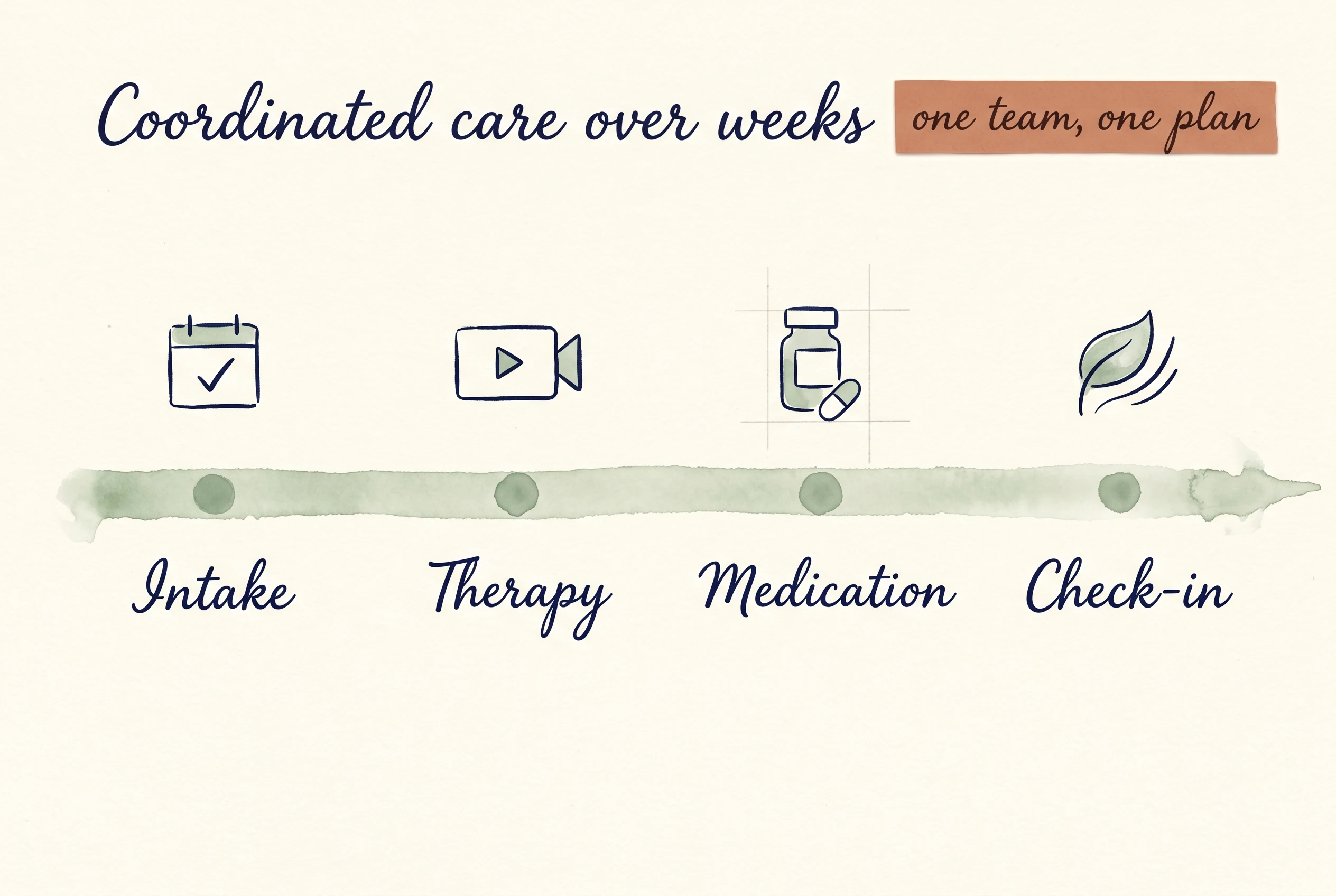
Where Talkspace bolted psychiatry onto a therapy product, Brightside was built psychiatry-first and added therapy alongside. The practical difference: when you're on both, the therapist and psychiatrist see the same clinical record and coordinate. For readers whose treatment really does involve both meds and therapy, that coordination is more valuable than the marketing makes it sound.
-
Teen Care for adolescents
A dedicated program for adolescents (ages and state availability vary; check during intake). Most major consumer telehealth platforms don't serve under-18s at all; Brightside does. Built specifically for the developmental window, with appropriate clinical guardrails and parental-consent flows.
Where it's limited
-
No controlled substances — same as every other online platform
Brightside psychiatrists prescribe SSRIs, SNRIs, mood stabilisers, and non-stimulant ADHD medications. They do not prescribe stimulants (Adderall, Vyvanse, etc.), benzodiazepines (Xanax, Klonopin), or controlled sleep medications. This is a regulatory limit shared with Talkspace and most online psychiatry — but if your treatment specifically needs a controlled medication, you'll need a local prescriber regardless of platform.
-
Therapy alone is expensive for what you get
Standalone therapy at $299/month buys you four video sessions and unlimited messaging — fewer sessions per month than BetterHelp's weekly model (≈4–5 sessions) at a similar or higher price, and significantly more than Online-Therapy.com's Basic ($240/mo) or Standard ($360/mo with weekly live session) tiers. If you only want talk therapy and don't need psychiatry, Brightside isn't the cost-efficient choice.
-
US-only — no international support
Brightside operates exclusively in the US. Unlike BetterHelp (which matches users in the UK, Canada, Australia, and parts of the EU through local-licensed therapists), Brightside has no path for international readers. Outside the US, look at locally licensed telehealth or your country's public mental-health system.
-
The culture is psychiatry-first — not a fit if you don't want medication
Brightside's design, marketing, outcome data, and clinician selection all centre on medication as part of the treatment picture. If you're explicitly looking for talk therapy without considering medication, the orientation will probably feel off. BetterHelp or Online-Therapy.com is a more natural fit for therapy-only readers.
-
Teen Care availability varies by state
Adolescent psychiatry is more regulated than adult care, and Brightside's Teen Care isn't available in every state. Check during intake before committing — if your state isn't covered, you'd need a local adolescent psychiatrist or in-person clinic.
Pricing and access
| Psychiatry only | $95/month + your Rx copay (after the initial evaluation, which is billed separately). Includes ongoing medication management and provider messaging. |
|---|---|
| Therapy only | $299/month. Four video sessions per month plus unlimited messaging with a licensed therapist. Note: if you only want therapy, BetterHelp or Online-Therapy.com is usually cheaper. |
| Combined plan | $349/month. Therapy + Psychiatry on one coordinated account. The plan that makes the platform make the most sense. |
| With insurance | Typical copay $15–$30 per session with Aetna, Cigna/Evernorth, Anthem Blue Cross, UnitedHealthcare (select states), Medicare, TRICARE, Allegiance, Ambetter, several Medicaid plans. |
| Crisis Care | Separate 4–12 week structured program. Covered by most accepted insurance plans; verify your specific coverage during intake. Not available as standalone self-pay outside the broader Brightside account. |
| Teen Care | Available in select states only. Adolescent psychiatry is more regulated than adult care. Check during intake whether your state is supported before committing. |
| Geography | US-only. No international users; no path for readers outside the US. Look at locally licensed telehealth or your country's public mental-health system. |
| Cancellation | From account settings. Monthly billing. Outstanding prescription needs and any Crisis Care commitments should be handled with your provider before cancelling. |
How Brightside compares to the alternatives
Four platforms cover most of the online-therapy market. Here's where Brightside fits — the Brightside column is highlighted.
| Dimension | BetterHelp | Talkspace | Online-Therapy.com | Brightside |
|---|---|---|---|---|
| Best for | Out-of-pocket weekly therapy, fast match | Insurance + psychiatry combo | Structured CBT program | Therapy + medication coordinated |
| Starting price (cash) | $65–$100/week | $69–$109/week | $48/week (Basic, no live sessions) | $95/mo psychiatry · $299/mo therapy · $349/mo combined |
| Insurance | Limited (some plans Jan 2026) | Broad in-network — Aetna, Cigna, BCBS, UHC, Medicare | None — superbills for out-of-network only | Broad incl. Medicaid (~55M reach) |
| Psychiatry | No prescribing | Yes — non-controlled meds, separate plan | No prescribing | Yes — PrecisionRx, non-controlled meds |
| Crisis program | No | No | No | Crisis Care — CAMS-based, 4–12 weeks |
| Privacy track record | 2023 FTC settlement ($7.8M) | 2020 NYT report + 2024 TikTok class action | Clean — no lawsuits in 16 years | Clean — no known privacy issues |
| Where to skip | Insurance-needed, psychiatry-needed | International, controlled medications | Insurance-needed, non-CBT modalities | Therapy-only readers, international |
Cross-links: BetterHelp review · Talkspace review · Online-Therapy.com review · Talkspace vs BetterHelp head-to-head.
How to get the most out of it
If you do sign up, these five practices are the difference between coordinated care that actually moves things and a subscription that quietly auto-renews.
-
Verify your insurance before paying out of pocket
Brightside's pricing case improves dramatically with insurance — typical copay drops to $15–$30 from the $95/$299/$349 self-pay rates. Before signing up, check your insurance member portal AND ask Brightside intake whether your specific plan and state are supported. Don't assume parity across plans.
-
Pick the plan that matches your actual need
If you only want medication, $95/mo Psychiatry is the right plan. If you only want therapy, the $299/mo Therapy plan is overpriced compared to BetterHelp or Online-Therapy.com — consider those instead. The $349/mo Combined plan only makes sense if you actually want both legs of treatment coordinated.
-
Don't expect controlled substances — plan for a local prescriber if you need them
If your treatment plan includes stimulants for ADHD, benzodiazepines for acute anxiety or panic, or controlled sleep medications, Brightside cannot prescribe them. You'll need a local psychiatrist for those, even if you use Brightside for everything else. Worth confirming before signing up if controlled meds are on the table.
-
Use the coordinated-care advantage if you're on both legs
The reason to choose Brightside over keeping a separate prescriber and therapist is the shared clinical record and live coordination between the two. If you're on both Psychiatry and Therapy, make sure your therapist knows about medication changes and your psychiatrist sees the therapy progress notes. That's the value the platform exists to deliver — actually using it is on you.
-
If symptoms escalate, ask about Crisis Care explicitly
Crisis Care isn't the default Brightside experience — it's a separate program. If you're already a member and you're hitting elevated suicide risk, ask your provider about transitioning to Crisis Care explicitly. Don't assume the platform routes you there automatically; it's a structured, CAMS-trained referral.
Free or cheaper alternatives
Brightside's price drops dramatically with insurance — verify first. If cost is still the issue, these three are the ones I'd point a reader to first.
- 988 Suicide and Crisis Lifeline (US) Free, 24/7 call or text. The first move if you're in immediate danger — Brightside Crisis Care is the next-day program, not the right-now one.
- SAMHSA Treatment Locator Federal directory of community mental health centres and substance-use treatment programmes near you. Many bill Medicaid or offer sliding-scale fees.
- GoodRx Care psychiatry Lower-cost online psychiatry with prescription coupon integration. Not as research-backed as Brightside, but useful for cost-sensitive readers who just need medication refills.
Common questions
Can Brightside psychiatrists prescribe my current medication?
Probably, if you're on a non-controlled medication: SSRIs, SNRIs, mood stabilisers, non-stimulant ADHD options (atomoxetine, viloxazine, etc.). They cannot prescribe controlled substances — stimulants for ADHD (Adderall, Vyvanse, Ritalin), benzodiazepines (Xanax, Klonopin, Ativan), or controlled sleep medications. If you're on a controlled medication, you'll need a local prescriber for that, even if you use Brightside for everything else.
How does Brightside compare to BetterHelp and Talkspace?
Three short answers. If you need medication and therapy together, Brightside is the strongest of the three — psychiatry-first design, coordinated care, published outcome data. If your insurance covers Talkspace and you don't need medication, Talkspace is usually cheaper after copay. If you only want talk therapy without medication, BetterHelp at ~$65–$100/week is more cost-efficient than Brightside's $299/mo therapy plan. For the head-to-head between the two market leaders, see Talkspace vs BetterHelp: which one I'd pick.
Is the Crisis Care program right for me if I'm having suicidal thoughts?
Crisis Care is built specifically for elevated suicide risk — active suicidality, recent suicide attempt, or post-hospitalization follow-up — and the published outcomes are real (77% elimination of suicidal ideation within 12 weeks, 4.3× higher remission than control). That said, the program runs on a 24–72 hour appointment window, not real-time. If you're in immediate danger right now, please call or text 988 (US), Samaritans (UK) 116 123, or Telefonseelsorge (Germany) 0800 111 0 111 first. Crisis Care is the next-day step — not the right-now one.
Does Brightside accept Medicaid?
Yes — and this is one of its meaningful differentiators. Brightside accepts several Medicaid plans alongside Aetna, Cigna/Evernorth, Anthem Blue Cross, UnitedHealthcare (select states), Medicare, TRICARE, Ambetter, and Allegiance. Coverage varies by state and specific Medicaid plan — verify in your member portal before signing up. Most of Brightside's major competitors (BetterHelp, Online-Therapy.com) don't accept Medicaid at all; Talkspace accepts insurance widely but not Medicaid either.
What's the difference between PrecisionRx and what my local psychiatrist does?
PrecisionRx is a clinical decision-support tool — it surfaces medication candidates to the psychiatric provider based on your symptom cluster, history, and a database of medication outcomes. Your psychiatrist still makes the prescribing call; the tool helps them get it right faster. The published feasibility paper in BMC Psychiatry covers the approach. A skilled local psychiatrist without the tool can absolutely match Brightside's outcomes — the question is whether the algorithmic assist (and the coordinated-care platform around it) is worth the access tradeoff for your situation.
When is Brightside the wrong choice?
International readers (US-only platform). Anyone who needs controlled substances (stimulants, benzodiazepines, controlled sleep meds). Readers who only want talk therapy — BetterHelp or Online-Therapy.com is more cost-efficient. Anyone wanting to pick a specific named therapist before paying (Brightside uses matching, not directory browsing). Severe complex trauma, eating disorders, or substance use disorders that need close in-person monitoring. And situations where your state isn't on the Teen Care list if you're seeking adolescent psychiatry.