
Reviewed by
Antonia Moosmann
Psychologist in Germany, M.Sc. Clinical Psychology. I review platforms the way I'd evaluate them for a real client — evidence, fit, limits, and the parts that don't make the marketing.
Read more about how I reviewKey facts
In a hurry? Here's the short version.
- Try Online-Therapy.com if you want a structured CBT program with worksheets and a licensed therapist's support, and you're paying out of pocket at $240–$480/month.
- Skip it if you need direct insurance billing, non-CBT modalities (DBT/ACT/psychodynamic/EMDR), or medication management.
- Pricing in 2026: Basic $240/mo (no live sessions), Standard $360/mo (1 weekly live), Premium $480/mo (2 weekly live). 20% off first month. Billed monthly.
- Privacy: Cleanest record in consumer telehealth — 16+ years operating since 2009 with no lawsuits or FTC settlements. 256-bit encryption, auto-delete after two years, nickname option.
- Financial aid for students, veterans, low-income readers. Application during signup.
- Not a crisis tool. If you're in danger, call or text 988 in the US, 111 in the UK, or Telefonseelsorge 0800 111 0 111 in Germany.
Visit Online-Therapy.com Affiliate link
What is Online-Therapy.com?
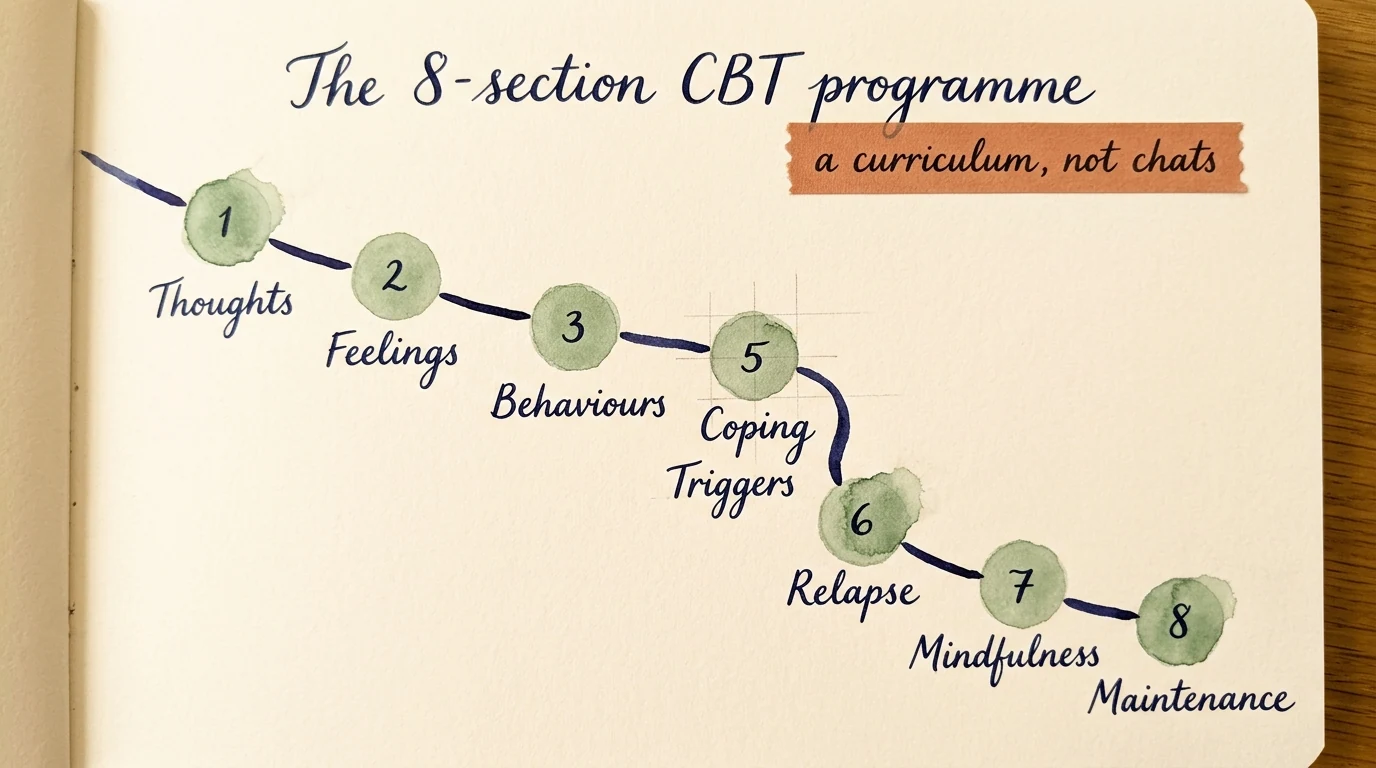
Online-Therapy.com is a structured cognitive behavioural therapy program with a licensed therapist's support — not a generic find-a-therapist marketplace. The product is an 8-section CBT course built around 25 interactive worksheets, a daily journal, an activity planner, and a yoga and meditation library; your live-session therapist works alongside that structure rather than starting from scratch.
The course video is led by Dr. Elizabeth Lombardo, PhD, a named clinical psychologist; the video material covers each section's CBT concepts, and your separately licensed therapist works with you on the worksheets, the live session, and the messaging in between. The structure is the product. For readers who want CBT specifically — the most evidence-supported modality for anxiety, panic, OCD, and mild-to-moderate depression — that match between what's marketed and what's delivered is unusually tight.
The structural difference from BetterHelp and Talkspace matters: those are therapist marketplaces — pay, get matched, your clinician decides the approach. Online-Therapy.com is a program — the structure carries you, and the therapist is one component of how you get through it. Some readers love that scaffolding; others find it homework-heavy. Worth knowing before signing up.
How I evaluated it
Four criteria. The same ones I use for any platform I'd consider recommending.
-
Credentialed clinicians
Every therapist on the platform must be licensed in the state where they practice. Verification happens before they join. First-match satisfaction is around 84% per independent user surveys, similar to BetterHelp and Talkspace.
-
Evidence + clinical fit
The 8-section CBT program is structured around standard CBT protocols — cognitive restructuring, behavioural activation, exposure-style exercises. The most evidence-supported modality for mild-to-moderate anxiety and depression. The fit between what's been studied and what you're buying is unusually tight.
-
Transparent pricing
Three named tiers (Basic, Standard, Premium) plus Couples. All prices public, all features public, the 20% first-month discount disclosed upfront. No surprise charges. Billing is monthly, not every-four-weeks, so the maths are simpler than BetterHelp's.
-
Privacy and data handling
HIPAA compliant, 256-bit end-to-end encryption, encrypted databases at rest, automatic deletion after two years, nickname-only option. No lawsuits, no settlements, no data-mining reporting in 16+ years of operation.
My verdict
Genuinely useful for the right reader — and the only big three with a clean privacy record.
Online-Therapy.com is the rare platform where what's marketed and what's delivered match: a structured CBT program with a licensed clinician's support. For mild-to-moderate anxiety, low mood, panic, or perfectionism — the symptom profiles CBT is strongest on — it delivers what it advertises. The honest caveats are the lack of insurance routing, the CBT-only scope, and the rougher operational layer (rescheduling friction, occasional video glitches). None of those are dealbreakers for the right reader — but they should be the reasons you choose it, not surprises after you sign up.

What it does well
-
An actual structured CBT program, not just a therapist directory
Most online platforms are 'find a therapist online.' Online-Therapy.com is different: an 8-section CBT course (videos guided by Dr. Elizabeth Lombardo, PhD, plus audio and reading), built around 25 interactive worksheets, a journal, an activity planner, and yoga/meditation videos. Your therapist works alongside the structure rather than starting from scratch. For readers who want CBT specifically — the most-evidence-supported modality for anxiety, panic, and mild-to-moderate depression — that structure is the product.
-
Clean privacy track record since 2009
16+ years of operation with no lawsuits, no FTC settlements, no data-mining reporting. End-to-end 256-bit encryption, encrypted-at-rest databases, automatic account deletion two years after submission, and a nickname-only option so the therapist never has to see your real name. Compared to BetterHelp's 2023 FTC settlement and Talkspace's 2020 NYT transcript-mining plus 2024 TikTok-pixel class action, this is the cleanest privacy history in the consumer telehealth space.
-
Lowest entry price among the big three
The Basic plan at $240/month ($48/week, or $40/week after the 20% first-month discount) gives you the full CBT toolkit and unlimited messaging with a licensed therapist — without live sessions. That's structurally the same product as Talkspace's messaging-only tier at $69/week, for roughly a third less. If live sessions aren't the part that matters most to you, the entry-level price is genuinely competitive.
-
Financial aid for students, veterans, and low-income readers
An actual application during signup — not buried, not a marketing line. Few commercial telehealth platforms offer this explicitly. For readers who couldn't afford BetterHelp or Talkspace's full rates, this is a real, named option rather than a vague 'sliding-scale' gesture.
-
Longer live sessions than BetterHelp
Live sessions are 45 minutes — longer than BetterHelp's typical 35–40 minutes, shorter than the traditional in-person 50. That extra 5–10 minutes is the difference between a session that ends mid-thought and one that closes properly.
Where it's limited
-
No insurance — superbills only
Unlike Talkspace, Online-Therapy.com doesn't bill insurance directly. They will generate a superbill (the receipt format insurance reimburses) for out-of-network reimbursement, but that means you pay full price upfront and chase the rebate. For readers whose plan covers Talkspace in-network at $0–$30 copay, the cost case usually still favours Talkspace.
-
CBT-only — no DBT, ACT, psychodynamic, or EMDR
The structured CBT program is the strength and the limit. For panic, anxiety, OCD (as ERP), or mild-to-moderate depression, CBT is the strongest first-line modality. For complex trauma, BPD-pattern relationships, recurrent depression with no clear cause, or values-disconnect that hasn't responded to CBT, you'd want a different platform — see the modalities guide.
-
No psychiatry or medication management
Like BetterHelp, Online-Therapy.com doesn't prescribe. If you need medication alongside therapy, Talkspace is the only one of the three with integrated psychiatry — or you'd combine Online-Therapy.com with a separate local or online prescriber.
-
Rescheduling friction is the most common complaint
Across independent reviews and Trustpilot, the recurring complaint isn't therapist quality — it's the friction of rescheduling cancelled sessions, occasional video glitches, and customer service that's slow to respond when something breaks. The therapists are praised; the platform's operational layer is rougher than BetterHelp's.
-
The format is rigid by design
If you want a therapist who'll just listen and follow where the conversation goes, the structured-program format may feel constraining. Some readers love that structure; others find it homework-heavy. Worth knowing before you sign up.
Pricing and access
| Basic ($48/wk) | $240/month. Full 8-section CBT course, 25 worksheets, journal, activity planner, yoga + meditation library, unlimited messaging with your therapist (Mon–Fri, 24h response). No live sessions. |
|---|---|
| Standard ($90/wk) | $360/month. Everything in Basic, plus 1 × 45-minute live session per week (video, voice, or text — your pick). |
| Premium ($120/wk) | $480/month. Everything in Standard, plus a second weekly 45-minute live session. |
| Couples Therapy | $480/month. CBT toolkit adapted for couples, plus one weekly 45-minute joint session with a couples-trained therapist. |
| Discount | 20% off the first month for new users. Discount disclosed at signup; applies to all tiers. |
| Insurance | Not billed directly. Online-Therapy.com generates a superbill for out-of-network reimbursement; you submit to your insurance. Reimbursement varies wildly by plan. |
| Financial aid | Available for students, veterans, and low-income readers. Application happens during signup — not buried, not a marketing line. |
| Cancellation | From account settings. Billing is monthly (not every-four-weeks like BetterHelp), so the maths are simpler. |
How Online-Therapy.com compares to the alternatives
Four platforms cover most of the online-therapy market. Here's where Online-Therapy.com fits — its column is highlighted.
| Dimension | BetterHelp | Talkspace | Online-Therapy.com | Brightside |
|---|---|---|---|---|
| Best for | Out-of-pocket weekly therapy, fast match | Insurance + psychiatry combo | Structured CBT program | Therapy + medication coordinated |
| Starting price (cash) | $65–$100/week | $69–$109/week | $48/week (Basic, no live sessions) | $95/mo psychiatry · $299/mo therapy · $349/mo combined |
| Insurance | Limited (some plans Jan 2026) | Broad in-network — Aetna, Cigna, BCBS, UHC, Medicare | None — superbills for out-of-network only | Broad incl. Medicaid (~55M reach) |
| Psychiatry | No prescribing | Yes — non-controlled meds, separate plan | No prescribing | Yes — PrecisionRx, non-controlled meds |
| Crisis program | No | No | No | Crisis Care — CAMS-based, 4–12 weeks |
| Privacy track record | 2023 FTC settlement ($7.8M) | 2020 NYT report + 2024 TikTok class action | Clean — no lawsuits in 16 years | Clean — no known privacy issues |
| Where to skip | Insurance-needed, psychiatry-needed | International, controlled medications | Insurance-needed, non-CBT modalities | Therapy-only readers, international |
Cross-links: BetterHelp review · Talkspace review · Brightside review · Talkspace vs BetterHelp head-to-head.

How to get the most out of it
If you do sign up, these five practices are the difference between a useful month of structured therapy and a subscription that quietly auto-renews.
-
Pick the right tier — the Basic plan is genuinely useful
If you want CBT structure and don't need a weekly live conversation, the Basic plan is a real product. The 8-section program + worksheets + messaging with a licensed therapist does the work for many readers. Don't reflexively upgrade to Standard if you're not sure you'll use the live session.
-
Do the worksheets, not just the reading
The platform's strongest feature is the structure. The worksheets are designed to be filled in — answers come back to your therapist within 24 hours and shape the next message or session. Treat them as homework, not optional reading.
-
Use the nickname option if privacy matters to you
Your therapist doesn't have to see your real name. For readers who'd feel more honest under a pseudonym (or who don't want a therapy record under their real identity for any reason), it's a small but unusual privacy lever.
-
Apply for financial aid if cost is the issue
Students, veterans, and low-income readers are eligible. The application is during signup, not a separate process. Don't skip it because you assume you don't qualify.
-
Plan around the rescheduling friction
If your weekly slot is unreliable (shift work, caregiving, travel), know that rescheduling is the most-complained-about part of the platform. Pick a session time you can actually hold every week, not 'when I might be free.'
Free or cheaper alternatives
Online-Therapy.com's price is the friction it doesn't remove. If cost is the issue, these are the three I'd point a reader to first — all of them overlap with what the platform's program teaches.
- Centre for Clinical Interventions (CCI) workbooks Free, clinician-authored CBT workbooks from Australia's public health system. Covers anxiety, depression, panic, perfectionism, low self-esteem, and more.
- NHS Talking Therapies (UK) Self-referral or GP-referral to NHS-funded CBT-based programmes — no cost to the user. Largely the same evidence base Online-Therapy.com's program is built on.
- Therapist Aid (US) Free CBT worksheets used by clinicians worldwide. Not therapy on its own — but excellent paired with any therapist or as a starting point.
Common questions
Is Online-Therapy.com actually CBT, or is that marketing?
It's actually CBT. The 8-section course is built around standard CBT components — cognitive restructuring, behavioural activation, exposure-style exercises, thought records via the worksheets. The video guidance is by Dr. Elizabeth Lombardo, PhD, a named clinical psychologist. Your live-session therapist is a separately licensed clinician who works alongside the structured course. The fit between what's marketed and what's delivered is unusually tight.
How does Online-Therapy.com compare to BetterHelp and Talkspace?
Three short answers. If you want structured CBT specifically, Online-Therapy.com is the only one of the three that's actually a CBT program — BetterHelp and Talkspace are find-a-therapist marketplaces. If your insurance covers Talkspace, Talkspace is usually cheaper after copay and offers psychiatry on the same platform. If you're paying out of pocket and want the largest therapist pool, BetterHelp is the default. For the head-to-head between the two market leaders, see Talkspace vs BetterHelp: which one I'd pick.
Does insurance cover Online-Therapy.com?
Not directly. The platform doesn't bill insurance. They will generate a superbill — the receipt format insurance reimburses for out-of-network care — which you submit to your insurance for partial reimbursement. The catch is you pay full price upfront, and the reimbursement varies wildly by plan (some readers get 50–80%, some get nothing). If insurance routing is your main cost lever, Talkspace's in-network coverage is structurally a better fit.
Is the Basic plan ($240/month, no live sessions) actually therapy?
It's structured self-help with a licensed clinician's oversight. That sits somewhere between a workbook and traditional therapy — closer to therapy than a workbook (because a real licensed person responds to your worksheets and messages within 24 hours), closer to a workbook than traditional therapy (because there's no live session). For mild-to-moderate symptoms and readers who write better than they talk, the Basic plan is a real product. For readers who need real-time conversation, upgrade to Standard or pick a different platform.
Has Online-Therapy.com had any privacy or data issues?
Not as of 2026 — no lawsuits, no FTC settlements, no documented data-sharing scandals across 16+ years of operation. This is in striking contrast to BetterHelp's 2023 FTC settlement ($7.8M over sharing health data with Meta and Snapchat) and Talkspace's 2020 NYT reporting on transcript-mining plus 2024 California class action over TikTok pixel tracking. Clean records are easy to mention; this one is unusually clean.
When is Online-Therapy.com the wrong choice?
Active crisis or recent self-harm — call 988 or your local crisis line first. Complex trauma, severe symptoms, BPD-pattern presentations, eating disorders, or substance use disorders that need close monitoring. Conditions where the modality match isn't CBT (psychodynamic for recurrent depression with no clear cause, DBT for emotion dysregulation, EMDR for single-event trauma). If you need medication management, you'd combine this with a separate prescriber. And situations where your insurance only covers in-network platforms — Online-Therapy.com isn't one.