
Written and reviewed by
Antonia Moosmann
Psychologist in Germany, M.Sc. Clinical Psychology. I write these guides the way I'd answer the question if you asked me in person — naming where each modality is strong, where it's oversold, and what I'd actually start with for the problem at hand.
Read more about how I reviewKey facts
In a hurry? Here's the short version.
- The modality is the method. CBT, DBT, ACT, psychodynamic, EMDR — each is a tradition with a different theory, structure, and evidence base. They're not competitors; they're tools.
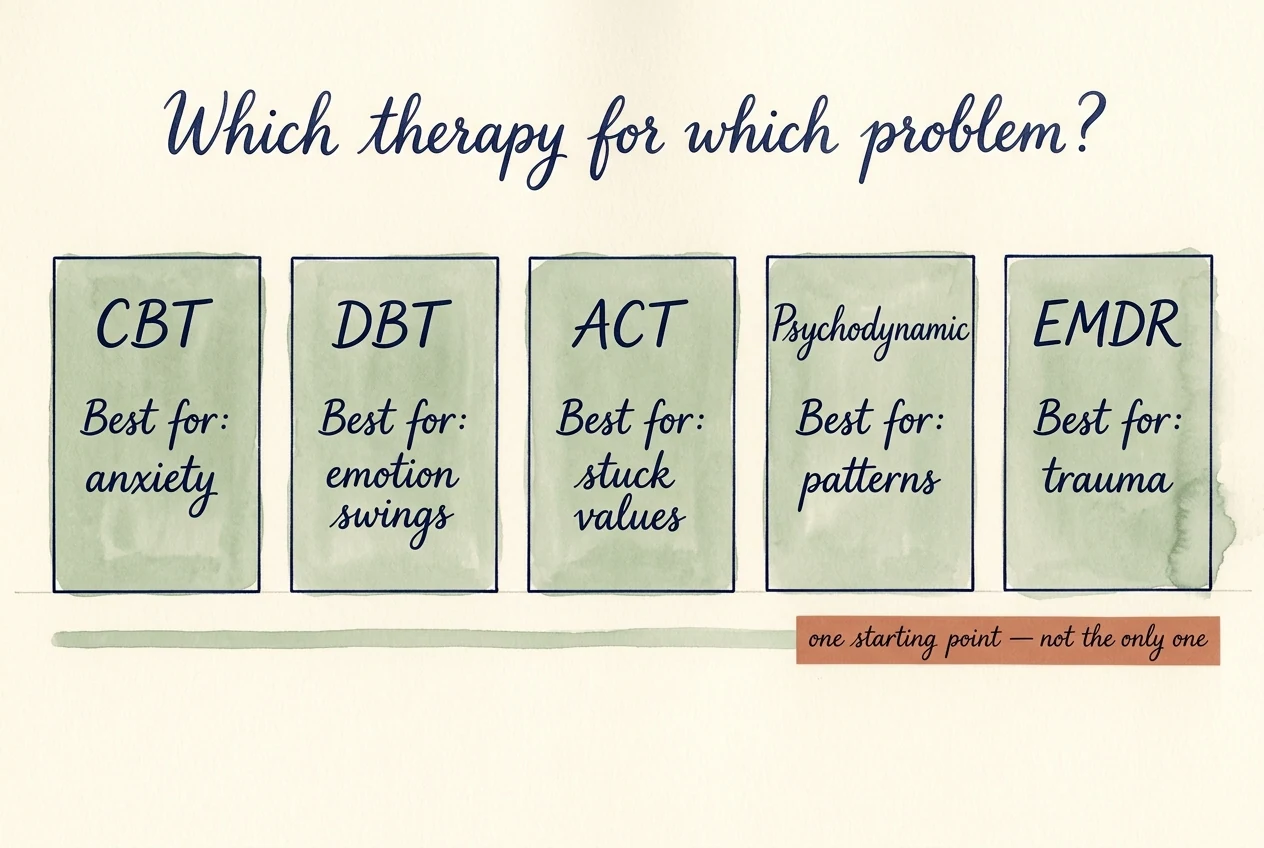
- Match the modality to the problem, not the brand. CBT for anxiety, panic, OCD (specifically as ERP), and mild-to-moderate depression. DBT for emotion flooding and self-harm patterns. ACT for stuck-in-your-head perfectionism. Psychodynamic for recurring patterns. EMDR for single-incident trauma.
- "CBT is the gold standard" is half-true. Gold for specific problems; oversold as a universal solution.
- For most problems, the therapist matters more than the brand of therapy. The exceptions are highly-protocolised work (ERP for OCD, CBT-E for eating disorders, full DBT for BPD patterns).
- This page is background. For the workbooks I'd pair with each, see CBT workbooks and DBT workbooks. For online platforms, see is online therapy effective? and the BetterHelp review.
The right therapy for a problem is rarely the most popular therapy. It's the one whose mechanism matches what's actually stuck — and that match is what the rest of this page is for.
Start here
What "type of therapy" actually means
When people say "I'm doing CBT" or "I want to try DBT," they're naming the modality — the theoretical tradition and method the therapist works from. It's a different question from:
This page is about the first one. The map below assumes you've already chosen the format and you're picking a therapist; the modality question helps you ask sharper questions of whoever you're considering.
The shortlist
The five modalities most people actually encounter
There are dozens of named therapy approaches. In day-to-day practice — in research-funded clinics, in NHS or German Kassen systems, and on commercial platforms — five do most of the work. Here's each in plain English.
| Modality | Core idea | Structure | Strongest evidence for |
|---|---|---|---|
| CBT Cognitive Behavioural Therapy | Thoughts, feelings, and behaviours hold each other in place. Change one and the others follow. | Short-to-medium term, 8–20 sessions. Homework. Skill-building. Often manualised. | Anxiety disorders, depression, panic, OCD (as ERP), specific phobias, insomnia. |
| DBT Dialectical Behaviour Therapy | Two truths at once: accept yourself as you are, and work to change. Built around four skill modules — mindfulness, distress tolerance, emotion regulation, interpersonal effectiveness. | Longer term, often 6–12 months with weekly individual + weekly skills group + phone coaching. | Emotion flooding, self-harm patterns, chronic suicidality, borderline-pattern relationships, some eating-disorder presentations. |
| ACT Acceptance and Commitment Therapy | You don't have to win the argument with your own mind. Make room for difficult thoughts and feelings; act according to your values anyway. | Medium term, often 8–16 sessions. Less homework than CBT; more experiential exercises. | Stuck-in-your-head perfectionism, chronic pain with emotional distress, values disconnection, anxiety that hasn't responded to standard CBT. |
| Psychodynamic Psychodynamic Therapy | Patterns repeat. The way you relate to your therapist often mirrors patterns from earlier life. Insight into those patterns loosens them. | Longer term, often 1–3+ years. Weekly. Less structured; more exploratory. | Repeating relationship patterns, persistent low mood with no clear trigger, identity questions, recurrent depression. |
| EMDR Eye Movement Desensitization and Reprocessing | Targeted protocol for single-incident trauma. Bilateral stimulation (eye movements, tones, taps) while recalling the memory; reprocessing reduces its emotional charge. | Short-to-medium term for single events; longer for complex trauma. Highly protocolised. | PTSD from a single identifiable event. Some success with complex trauma in trauma-trained hands. |
IFS (Internal Family Systems), schema therapy, and somatic approaches also appear regularly — usually as part of integrative work, often layered onto one of the five above. Not on this table because they're less often a reader's first pick, but worth asking about for trauma and identity-level work.
The map
Problem → modality: where I'd start
This is the table the rest of the page exists for. Read it as "if X is what's bringing you, here's where I'd start" — not "this is the only thing that works." Real problems often need more than one tool over time, and a good therapist trained in one modality usually borrows from the others.
Panic attacks, health anxiety
Start with: CBT (with interoceptive exposure)
The most studied protocol for panic — and the one that holds up best across decades of evidence.
Social anxiety
Start with: CBT with exposure
Avoidance is the engine. Cognitive work alone usually isn't enough; graded exposure is the active ingredient.
OCD (intrusive thoughts + compulsions)
Start with: CBT specifically delivered as ERP (Exposure and Response Prevention)
Generic CBT often doesn't help OCD. ERP is the specific protocol with strong evidence; ask for a therapist who names ERP.
Mild-to-moderate depression with clear triggers
Start with: CBT or Behavioural Activation
Both have strong evidence. Behavioural Activation alone is sometimes enough — it's simpler and pairs well with low motivation.
Recurrent or persistent depression, unclear cause
Start with: Psychodynamic or depth-oriented therapy
When the pattern keeps coming back and CBT hasn't fixed it, a longer exploration of what underlies the pattern often does more.
Emotion flooding, self-harm, chronic suicidality, BPD-pattern relationships
Start with: DBT (full program)
DBT is the gold standard here. Individual + group + phone coaching together — picking and choosing modules dilutes the evidence.
Single-incident trauma (PTSD)
Start with: Trauma-focused CBT or EMDR
Both have NICE/APA backing for single-event PTSD. Pick the one whose mechanism makes sense to you; both work.
Complex / developmental trauma
Start with: Trauma-trained therapist + sometimes IFS or somatic work
Single-protocol therapy rarely covers this alone. Long, careful, and often integrative; the therapist's training matters more than the brand name.
Stuck in your head despite knowing better, perfectionism, values disconnect
Start with: ACT
When you've already figured out 'why' and it hasn't unstuck you, ACT moves the lever from understanding to values-driven action.
Chronic pain with emotional distress
Start with: ACT (chronic pain protocol)
Strong evidence for pain-related distress and functioning. Doesn't promise pain reduction; promises better life around the pain.
Substance use (mild-to-moderate)
Start with: Motivational Interviewing or CBT for substance use; consider DBT-SUD if dysregulation is dominant
Match to where ambivalence sits — MI for 'I'm not sure I want to stop,' CBT for 'I want to stop and need a method.'
Eating disorders
Start with: Specialised CBT-E (or family-based treatment for adolescents)
CBT-E is the dominant evidence base for adult eating disorders. Generic CBT doesn't substitute. For under-18s, FBT is first line.
Adjustment to a major life transition
Start with: Supportive or integrative therapy; modality matters less
What helps here is mostly relational. A therapist whose personality fits beats picking the 'right' modality.
When in doubt, the safe move is to name your actual problem clearly to a prospective therapist and ask what approach they'd take and why. A clear, specific answer is a green flag. "I do a bit of everything" is a softer one.
A good therapist trained in one modality usually borrows from the others. A weak therapist in any modality stays inside the manual.
Common claims, checked
Five things people repeat about therapy types — how true is each?
A lot of what gets passed around online about therapy modalities is half-right, which is worse than wrong. Here are the five I hear most.
-
"CBT is the gold standard."
True for some problems (panic, OCD via ERP, mild-to-moderate depression). Not universally true. Where CBT is strong, it's strong; where it isn't, calling it gold-standard is marketing.
-
"Psychodynamic therapy has no evidence."
Outdated. Several meta-analyses since 2010 show short-term psychodynamic therapy is effective for depression and some personality presentations, with results often holding up well in follow-up.
-
"DBT skills work without the full program."
Some skills (distress tolerance, simple mindfulness) help on their own. The full evidence base is for the full program: individual + group + coaching. A weekly DBT workbook and a non-DBT therapist isn't the same intervention.
-
"EMDR is the fastest fix for trauma."
For single-incident trauma, EMDR can move faster than long talk therapy. For complex/developmental trauma, claims of 'fast' protocols usually overpromise.
-
"The modality matters more than the therapist."
Across decades of psychotherapy outcome research, the relationship explains more variance than the modality — usually. Where it doesn't is the highly-protocolised work (ERP for OCD, CBT-E for eating disorders, DBT for BPD).
What to do with this
A handful of next steps that actually help
A note on sources
The map above is a working clinician's distillation of the modality-specific evidence base — NICE guidelines, APA Division 12 (Society of Clinical Psychology) lists of empirically supported treatments, the APA's empirically-supported treatments index , and the standard textbook coverage of CBT, DBT, ACT, EMDR, and short-term psychodynamic therapy.
Where I've made a specific recommendation (ERP for OCD, CBT-E for eating disorders, DBT for BPD-pattern presentations), I'm following the same consensus the major guidelines follow. Where I've pushed back on "gold standard" framing, I'm summarising the broader outcome literature on common-factors research (the relationship matters as much as the method for most problems).
Common questions
Which therapy is best for anxiety?
For most anxiety presentations, CBT with exposure is the strongest first choice. The exception is anxiety tied to perfectionism or values disconnect where you've already done the cognitive work — ACT often does more there. If anxiety is one symptom of a wider pattern (chronic worry, identity questions, relationship reactivity), a longer exploration might fit better than a focused CBT protocol.
Is CBT really the gold standard?
For specific problems (panic, OCD via ERP, mild-to-moderate depression), yes — CBT has the strongest evidence base. For complex trauma, recurrent depression, personality-pattern work, or values-level questions, calling CBT 'gold standard' overstates what the research actually shows. The honest answer is: gold standard for some problems, decent default for others, and a poor match for a few.
Can I do DBT skills without joining a full program?
You can practise the skills — and some of them (TIPP for distress tolerance, simple mindfulness exercises, opposite action) help on their own. But the evidence for DBT is for the full package: individual therapy, weekly skills group, and phone coaching, usually over six to twelve months. A DBT workbook alongside any therapist is a reasonable starting point if a full program isn't accessible — just don't expect workbook-only results to match program results.
What if my therapist doesn't say which modality they use?
It's a fair question to ask, and a good therapist will answer plainly. Common answers: 'mostly CBT-flavoured,' 'integrative,' 'psychodynamic with some CBT,' 'trauma-trained, mostly EMDR for single events.' If the answer is vague or defensive, that's data. If the therapist's approach doesn't seem to match your problem (e.g., long open-ended exploration for OCD that needs ERP), it's reasonable to ask whether a different modality might fit better.
What about EMDR — does it really work?
For single-incident PTSD, EMDR has strong evidence and is recommended by NICE and the APA alongside trauma-focused CBT. The mechanism is debated (whether the eye movements specifically do the work, or whether they're a useful distraction during exposure), but the outcomes are real. For complex or developmental trauma, EMDR alone is usually not enough; it tends to be one component of longer integrative work.
Does the therapist matter more than the modality?
For most problems, yes — the therapeutic relationship explains more of the outcome variance than the specific approach. The exceptions are highly-protocolised problems: ERP for OCD, CBT-E for eating disorders, DBT for severe emotion dysregulation. In those cases, the protocol does specific work that 'a good therapist who's nice to you' won't replicate.